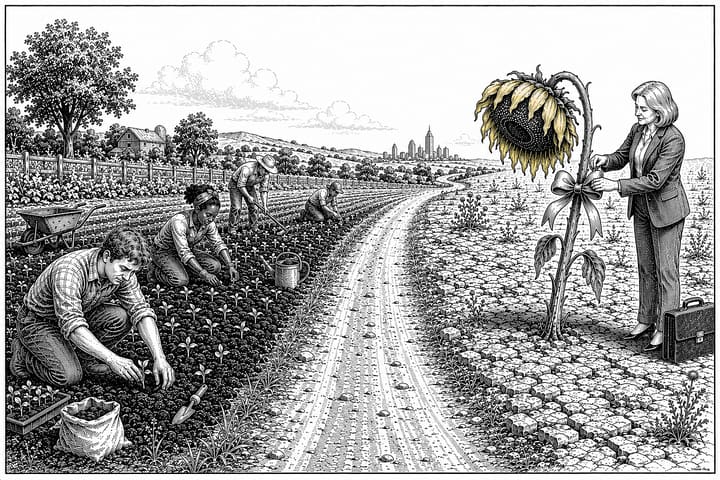
The Imagination Deficit
Why the Biggest Threat to Your Organization Isn’t AI - It’s a Lack of Vision

April 3, 202617 min read
Nathan Chappell · April 2026
Long before there were algorithms or data centers or artificial intelligence, there was a more radical innovation: the belief that people would voluntarily pool their resources to solve problems that markets and governments could not or would not solve on their own. That belief built the nonprofit sector. It was, and remains, the most audacious act of imagination in the history of organized society.
Today, that imagination is being tested.
Jensen Huang was not being diplomatic.
Sitting across from Jim Cramer at NVIDIA’s GTC conference last month, the CEO of the most valuable technology company on earth was asked a simple question: Why are so many companies using AI as a reason to lay people off?
His answer landed like a verdict.
“Because you’re out of imagination. For companies with imagination, you will do more with more. For companies where the leadership is just out of ideas, they have nothing else to do. They have no reason to imagine greater than they are. When they have more capability, they don’t do more.”
Read that again slowly. And if you lead a nonprofit, read it a third time.
The man whose chips power the AI revolution – whose hardware is running inside Meta, Amazon, Microsoft, and nearly every major tech company on the planet – just told their CEOs, on live television, that the problem isn’t the technology. The problem is them.
And then the data arrived to prove his point.
This week, Challenger, Gray & Christmas released its March 2026 job cut report. The numbers are stark. Artificial intelligence was the leading reason employers cited for layoffs in March, accounting for more than 15,000 of the roughly 60,600 announced cuts. That is twenty-five percent of all layoffs in a single month, up from ten percent in February and five percent across all of 2025. Since Challenger began tracking AI as a reason for workforce reductions in 2023, employers have now attributed nearly 100,000 job cuts to the technology.
The tech sector alone announced over 52,000 cuts in the first quarter of 2026 – a forty percent increase from the same period last year. Dell trimmed 11,000 positions. Meta is reportedly preparing to cut 15,000 employees, roughly twenty percent of its workforce, while simultaneously doubling its AI budget to $135 billion. Amazon eliminated 16,000 corporate roles in January, explicitly citing AI and automation. Microsoft cut more than 15,000 positions throughout 2025 while committing $80 billion to AI infrastructure.
These are not struggling organizations. These are among the most well-resourced, technologically sophisticated companies in the history of commerce. And yet the dominant response to the most powerful general-purpose technology since electricity has been to do the same work with fewer people.
I understand the pressures behind those decisions. I have friends and partners inside many of these companies, and I know the calculus is more nuanced than any headline suggests. But I keep coming back to Huang’s framing: when you are handed more capability than you have ever had, and your first instinct is to contract rather than expand, something beyond strategy is at work. Something closer to a failure of imagination.
Now, in fairness: there is a version of this calculus that makes sense in the for-profit world. If you are a publicly traded technology company reallocating capital from headcount to data center infrastructure, your board and your shareholders may reward that trade. The logic of quarterly earnings, competitive positioning, and capital expenditure has its own internal coherence. I am a capitalist. I understand the engine.
But the nonprofit sector does not run on that engine. There are no shareholders demanding that you cut fifteen percent of your staff to fund an AI buildout. There is no stock price that ticks up when you announce a leaner team. The currency of the social sector is trust, and trust is built by humans – in relationships, in communities, in the slow and irreplaceable work of presence. When a nonprofit leader looks at these headlines and reaches for the same playbook, they are importing a logic that was never designed for the mission they serve. And that matters, because what the nonprofit sector does with AI in this moment will look fundamentally different from what Silicon Valley does – or at least it should.
Meanwhile, a new report from Brookings Metro and Opportunity@Work landed the same week, and it tells a story that should keep every nonprofit leader awake tonight. The researchers examined what they call “gateway jobs” – mid-level stepping-stone roles like customer service representatives, administrative assistants, and bookkeeping clerks that have historically served as bridges between entry-level work and higher-wage careers. These roles are not just jobs. They are pathways. They are how people build skills, gain experience, and move toward economic stability.
The report found that nearly eleven million workers without college degrees hold gateway jobs that are highly exposed to AI disruption. And here is the part that reveals just how interconnected the damage could be: forty-nine percent of the career pathways connecting those gateway roles to higher-paying positions are also heavily exposed. In other words, AI is not just threatening individual jobs. It is threatening the very infrastructure of upward mobility.
In Florida, nearly one in three workers without degrees hold gateway jobs in the highest-risk category. The Northeast and Sun Belt are the most exposed regions. And three and a half million workers are in what the researchers call the most precarious position – high AI exposure combined with low adaptive capacity, meaning limited savings, few transferable skills, and unfavorable geographic circumstances.
This is not a labor market problem that efficiency can solve. This is a structural problem that demands imagination.
I have spent the better part of two years writing and speaking about curiosity as the defining human superpower of the AI age. The premise is simple and, I believe, increasingly undeniable: AI doesn’t wonder. It doesn’t get sidetracked by a fascinating idea. It doesn’t ask “what if?” It processes. It optimizes. It follows algorithms. If a machine is instructed to be curious, it isn’t truly curious – it’s simply following orders.
Curiosity is what enables us to see opportunities where others see obstacles. It is the spark that turns a new capability into a new possibility rather than a cheaper version of the old one.
And imagination is curiosity’s first child.
Imagination is what happens when curiosity meets courage. When a leader looks at AI and asks not “how many people can I replace?” but “what could we accomplish that was never possible before?” When an organization stops trying to do the same things faster and starts asking whether those are even the right things to be doing in the first place.
Jensen Huang was pointing at something essential when he made that comment. He was drawing a line between two fundamentally different responses to the same technological moment. One response contracts. The other expands. One optimizes the present. The other invents the future. And the dividing line between them is not budget or capability or access.
It is imagination.
And then, the same week the Challenger report landed, a different kind of story broke.
The New York Times profiled Matthew Gallagher, a 41-year-old self-taught entrepreneur from Los Angeles who grew up in a trailer park, taught himself to code on a gifted laptop, and in September 2024 launched a telehealth startup called Medvi from his house with $20,000 and a stack of AI tools. He used AI to write the code, produce the website, generate ad creative, handle customer service, and analyze business performance in real time. His only full-time employee is his younger brother.
In its first full year, the company generated $401 million in sales. It is now on track to reach $1.8 billion in 2026. Sam Altman had predicted in 2024 that a one-person billion-dollar company would eventually become possible through AI. Gallagher may have just delivered the proof of concept.
Now, I want to be careful here. The Medvi story is not a simple fable. There are real questions about the model’s defensibility, its regulatory exposure in the GLP-1 market, and the broader ethical implications of ultra-thin healthcare architectures. I am not holding it up as a template for everyone to copy.
But what I find striking – and what connects Gallagher’s story to Huang’s critique – is what it reveals about the difference between imagination and optimization. Every established telehealth company in the space responded to AI the way most companies do: they used it to make existing operations slightly more efficient. Gallagher looked at the same technology and asked a fundamentally different question. Not “how can AI help us do what we already do with fewer people?” but “what kind of company becomes possible when AI is the starting assumption rather than the afterthought?”
He posted on social media after the story broke: “Grew up in a trailer park. NYT just released an article about my startup going from $0 to $1B in 14 months with one employee.”
That is not efficiency. That is imagination applied to scarcity. And perhaps most relevantly for the conversation I want to have with the nonprofit sector, Gallagher has announced the launch of The Gallagher Foundation, intended to fund entrepreneurs who use their talents for nonprofits and what he calls the “greater good.”
When I read the Gallagher story, I thought immediately of a phone call I received about a year and a half ago from a dear friend, Kaz McGrath, Founder and CEO of PLAI (Purpose Lead AI), who lives in Australia. She had just gotten access to ChatGPT Pro – the premium tier OpenAI had launched – and the first thing she did with it was ask the model to write her a business plan for a nonprofit that raised a billion dollars a year with six employees or fewer.
Let that sit for a moment.
She did not ask it to help her write a better fundraising email. She did not ask it to summarize a grant report. She asked it to reimagine the entire architecture of what a mission-driven organization could look like if you started from capability rather than constraint. That is the kind of thinking – that kind of curiosity and ambition – that our sector needs in spades.
Now, a six-person billion-dollar nonprofit is not a blueprint anyone should follow literally. That is not the point. The point is the question itself. The willingness to sit down with a powerful new tool and ask it to help you think at a scale you had never previously considered. Not to optimize the model you already have, but to imagine a model that does not yet exist. Gallagher did it in telehealth. Kaz did it for the social sector. And the distance between where most nonprofit leaders are right now and where that kind of question lives is not a technology gap. It is an imagination gap.
Which brings me to the part of this story I care about most.
Now here is where I need to say something directly to the nonprofit sector, because this is where I live and where the stakes are different – and, I would argue, higher.
The 2026 Nonprofit AI Adoption Report from Virtuous and Fundraising.AI found that ninety-two percent of nonprofit professionals now use AI at least occasionally. Only seven percent report meaningful improvements in organizational capability. That gap – between experimentation and transformation – is not a technology problem. It is an imagination problem.
Most nonprofit organizations that have adopted AI have done so within the existing architecture of how they work. They use it to write faster emails, summarize reports more efficiently, clean data more quickly. And those are genuinely useful applications. I do not dismiss them.
But they are the equivalent of getting a telescope and using it to read the newspaper from across the room.
The telescope was not built to do what you were already doing more comfortably. It was built to let you see things that were previously invisible.
AI is not a productivity tool. It is a possibility tool. And the organizations that treat it only as the former will never close the gap between the ninety-two and the seven.
So what does imagination actually look like inside a mission-driven organization? Let me try to make this concrete, because I believe the practical dimension is where most conversations about AI and imagination fall apart. It is easy to say “think bigger.” It is harder to show people what bigger looks like from where they are standing.
Consider a mid-sized food bank that currently uses AI to optimize delivery routes and predict demand patterns. Those are efficiency gains – valuable, but incremental. Now imagine the same food bank asking a fundamentally different question: What if we could predict food insecurity before it becomes acute? What if, by combining public health data, economic indicators, school enrollment patterns, and social service referrals, we could identify families sliding toward hunger and intervene before they ever need to visit us? And those are exactly the type of questions that the team at The FarmLink Project, where I serve on the board, are contemplating daily.
That is not an efficiency play. That is a reimagination of the food bank’s role in the community – from reactive distributor to proactive partner in well-being. And it is made possible not by more AI, but by more imagination applied to the AI that already exists.
Or consider what my friend Mallory Erickson did. Mallory is a fundraising consultant who has spent years working with development teams across the sector. She saw a problem that most people were trying to solve with the wrong question. The conventional approach to flagging fundraising revenue was to ask: How do we find more prospects? How do we build a bigger pipeline? How do we use AI to identify more people who might give?
Mallory asked a different question entirely. What if the problem was never the pipeline? What if the real constraint was that fundraising teams were insufficiently prepared to convert the prospects they already had? What if the bottleneck was not data, but confidence?
That question led her to build Practivated, an AI-powered donor conversation simulator that lets fundraisers practice real-world scenarios – discovery calls, major gift asks, tough objections, stewardship conversations – in a low-stakes environment with AI-generated donor avatars built from actual giving histories and personality profiles. The platform does not replace coaching. It scales it. Fundraisers get reps. Leaders get visibility into team-wide skill development. And organizations see measurable results: a thirty-three percent increase in ask effectiveness, a two hundred and eighty percent increase in donor outreach and engagement, and something that no CRM upgrade has ever delivered – fundraisers who feel more confident walking into the room.
That is imagination. Not using AI to write better appeal letters. Not using it to score more prospects. Using it to rethink why fundraising teams underperform in the first place and building a tool that addresses the actual root cause.
Or think about prospect research – a function that has existed in fundraising shops for decades. Most organizations that have introduced AI into prospect research have used it to do what they were already doing faster: scan wealth indicators, flag capacity ratings, surface giving histories. And those are legitimate improvements. But what if a development team used AI to do something that was previously impossible? What if, instead of scoring donors on their capacity to give, you could model their propensity to deepen a relationship over time – mapping not just wealth, but affinity patterns, engagement cadence, communication preferences, and life-stage transitions to predict not who can give the most, but who is most ready to be invited into a deeper conversation about your mission? That reframes the entire function from transactional screening to relational intelligence. And it changes who your team calls first on Monday morning.
None of these applications require technology that does not already exist. They require leaders who are willing to step outside the boundaries of their current operating model and ask the question that Jensen Huang is asking the tech industry to ask: What would we do if we had more capability than we’ve ever had before?
I want to be honest about something. The reason most organizations default to the efficiency frame is not because their leaders are unintelligent. It is because imagination is harder. Efficiency is measurable. It fits into a board presentation. You can show that you reduced costs by fifteen percent or processed donations thirty percent faster. Those are real numbers that satisfy real stakeholders.
Imagination does not come with a dashboard.
It asks leaders to advocate for outcomes they cannot yet quantify, to invest in capabilities whose value has not been proven, and to explain to boards and donors why the organization is pursuing something that looks different from what it has always done. That is uncomfortable. It requires a kind of leadership courage that the nonprofit sector desperately needs but rarely rewards.
And this is where curiosity re-enters the frame. Because curiosity is not just a personality trait. It is a leadership discipline. It is the practice of asking questions that do not have easy answers, of sitting with uncertainty long enough to see what emerges, of resisting the gravitational pull of the familiar long enough to glimpse something genuinely new.
When I talk about the Curiosity Code – the framework I have been developing over the past two years – this is what I mean. Curiosity is not whimsy. It is the mechanism by which organizations move from optimization to transformation. From doing the same things faster to doing entirely new things. From the ninety-two percent to the seven.
But I also want to say something that might be unpopular in a moment where the layoff headlines are dominating every feed.
Not all job cuts attributed to AI are actually caused by AI. Marc Andreessen said publicly last week that AI is a “silver bullet excuse” for companies that were already overstaffed after pandemic-era hiring sprees. The Challenger report itself notes that these are employer-stated reasons, not independently verified causes. Companies sometimes cite AI when the actual drivers are broader cost restructuring, market contraction, or strategic pivots that have nothing to do with the technology.
This matters because the narrative shapes the response. If we believe that AI is simply replacing humans at an accelerating rate, the logical response is to hunker down, protect what we have, and brace for impact. But if we recognize that many of these cuts reflect a failure of leadership imagination – combined with a convenient narrative that Wall Street rewards – then the appropriate response is entirely different. It is to lead differently. To imagine differently. To use this technology the way it deserves to be used: as an accelerant for mission, not a substitute for people.
Here is what I am asking nonprofit leaders to do. Not eventually. Now.
Stop asking “how can AI make us more efficient?” Start asking “what would we attempt if efficiency were no longer the constraint?”
Those are fundamentally different questions, and they lead to fundamentally different futures.
Convene your team – not for an AI training session, but for an imagination session. Give people permission to describe the organization they would build if they were starting from scratch today, with AI as a foundational capability rather than a bolt-on tool. You will be surprised by what emerges when you remove the weight of the existing operating model from the conversation.
Study the Brookings research on career pathways. If your organization touches workforce development, education, economic mobility, or community well-being in any way, the gateway jobs framework should be part of your strategic planning. The disruption is not hypothetical. It is arriving in monthly Challenger reports.
Build governance alongside vision. Imagination without responsibility is just another word for recklessness. The question I have returned to more times than I can count still holds: just because we can, does it mean we should? The organizations that ask that question before they scale will be the ones that earn and keep the trust of the communities they serve.
And lead with curiosity. Not as a buzzword. Not as a poster on the conference room wall. As a practice. Ask “what if?” more than you ask “how much?” Ask “who benefits?” before you ask “how fast?” Ask “what becomes possible?” instead of “what can we cut?”
The layoff numbers are going to keep climbing. The headlines will get louder. The pressure to respond with fear and contraction will intensify. And for the nonprofit sector – which has always operated closer to the margin, with less cushion and less room for error – the temptation to retreat into the familiar will be enormous.
But retreat is not strategy. And efficiency is not vision.
The organizations that will define the next decade of social impact are not the ones that use AI to do more with less. They are the ones that use AI to imagine more with more. More reach. More depth. More insight. More capacity for the irreplaceably human work of building trust, deepening relationships, and holding the moral line in a world that is moving faster than most of us can think.
Jensen Huang built the hardware that powers this revolution. But he cannot supply the imagination to use it well. That part is on us.
And the nonprofit sector – the sector built on the audacious belief that the world can be better than it is – has more imagination in its DNA than any industry on the planet.
It is time to act on it.
Nathan Chappell, MBA, MNA, CFRE, AIGP is Chief AI Officer at Virtuous, co-author of Nonprofit AI and The Generosity Crisis, and Founder of Fundraising.AI. He writes about responsible innovation, the future of generosity, and the power of human-centered leadership in the age of AI.
Originally published on Nathan’s Substack.