The Big Win
What ten thousand sunflowers taught me about AI, culture, and the work the sector keeps trying to skip

August 26, 202611 min read
The call arrives in some version of the same shape every few weeks. A senior leader at a large organization, sometimes the chief executive, sometimes the board chair, wants help thinking through an important AI decision. On a recent one, most of the thinking had already been done. Two consulting proposals sat on the table, both from reputable firms, both promising to identify the high-yield places where AI could produce measurable results inside a fiscal year. The decks were impressive. The references checked out. The leader wanted to know which one to pick.
I asked what they were trying to achieve.
“We want to find the big efficiencies. The big projects. The things we can point to and measure.”
I asked what the firms had promised to deliver.
“They told us they can help us find the big wins and move our organization along quickly.”
I asked what they were doing about the culture.
“We want to find the big wins and the low-hanging fruit and expand out from there.”
So again, I asked again about the culture.
That exchange has happened enough times now that I have stopped treating it as a communication failure. The question is not unclear. The question simply has no place to sit inside the conversation the leader is already having. Culture has no line item, no launch date, no vendor, and nothing to show a board in ninety days. At face value, the big win has all four.
So before we hung up I told that leader what I now tell everyone who asks me which proposal to pick. Buy either one. Execute it well. And unless you do the other work, the work nobody in your building is currently asking you about, you will call me in twelve or eighteen months to tell me it did not take.
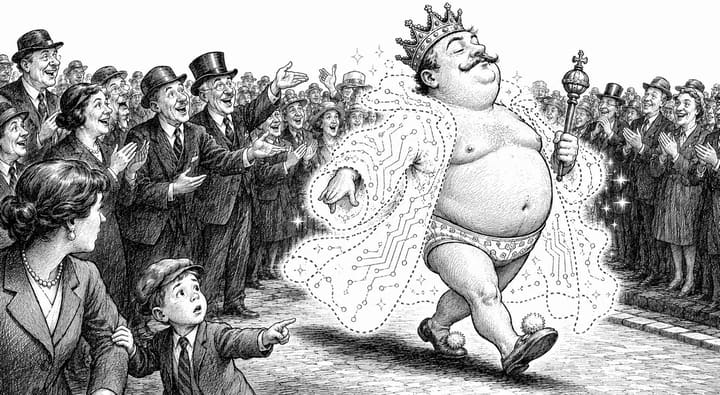
The pressure that produces these calls is not imaginary. It arrives as a trustee forwarding an article with a subject line that reads, in its entirety, “Are we doing this?” It arrives as a program officer asking a pointed question during a site visit. It arrives as a peer organization announcing an AI initiative from a conference stage. None of it is concrete, and none of it can be answered, because none of it is really a question. Together it produces a low and persistent hum that says everyone else is further ahead than you are.
Good leaders are accountable, and accountability wants something to act on. So the hum gets converted into the nearest available object, which is a project chosen to produce a “big win”.
The consulting firms get blamed for this, and I think the blame is misplaced. A market delivers what it is asked for. If nonprofit boards started asking for eighteen-month capability engagements with nothing to demonstrate at the end, there would be a hundred firms offering them by spring. The big win is being sold because the big win is being bought, and the big win is being bought because the big win is being demanded. Every party in that chain is behaving rationally and the outcome is still wrong.
There is also nothing wrong with the wins themselves. They are real. Gift officers really do get time back. Grant narratives really do get drafted in an afternoon. I have watched organizations recover meaningful capacity in a single quarter, and I would not undo any of it.
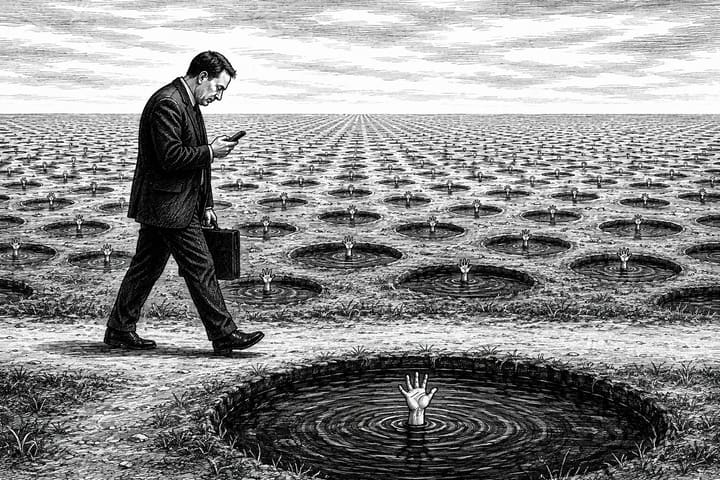
The trouble is what happens next, and we now have numbers on it. In this year’s adoption study that Virtuous and Fundraising.AI ran across 346 organizations, 92 percent reported using AI. But only seven percent reported meaningful impact on their mission. That gap is not a technology failure. Eighty-five percent of those organizations bought a bloom and never touched the ground.
I have spent this year learning what a bloom actually costs, and none of the learning happened in a conference room.
In April I tilled half an acre behind my house in Middle Tennessee and hand-seeded ten thousand sunflowers. This has become, improbably, the thing that people are curious about. People stop me at conferences to ask about the sunflowers. I get texts from people I have not spoken to in years. Friends from three thousand miles away know the field and the journey better than some of my neighbors do.
In all of that, across four months and several hundred conversations, not one person has asked me about the soil.
Everyone asks about the flowers. Nobody asks about the ground.
I understand why. The flowers are the part worth looking at. They are also, of the entire enterprise, the only part I had nothing to do with.
What I did was earlier and considerably less photogenic. Before April there was a field of grass that had never been asked to grow anything on purpose. I tilled it, which took longer than I expected. Then I tested the soil, which is the step nobody tells stories about and the step that changed everything downstream, because a soil test does not tell you what to plant. It tells you what your ground currently cannot support. Then I amended it, which is to say I spent money and time adding what was missing before a single seed went in, on the authority of a piece of paper, with no visible evidence that any of it was working.
Then ten thousand seeds, one at a time, an inch and a half deep and eighteen inches apart, in a window narrow enough that I was reading forecasts for rain that would come but not too heavily, just enough to hold ten days of moisture in the ground for the seed to propagate. And then the waiting, which I have written about elsewhere and will not relitigate here, except to say that nothing in my professional life had prepared me to be a person who had spent real money turning a field into a dirt lot.
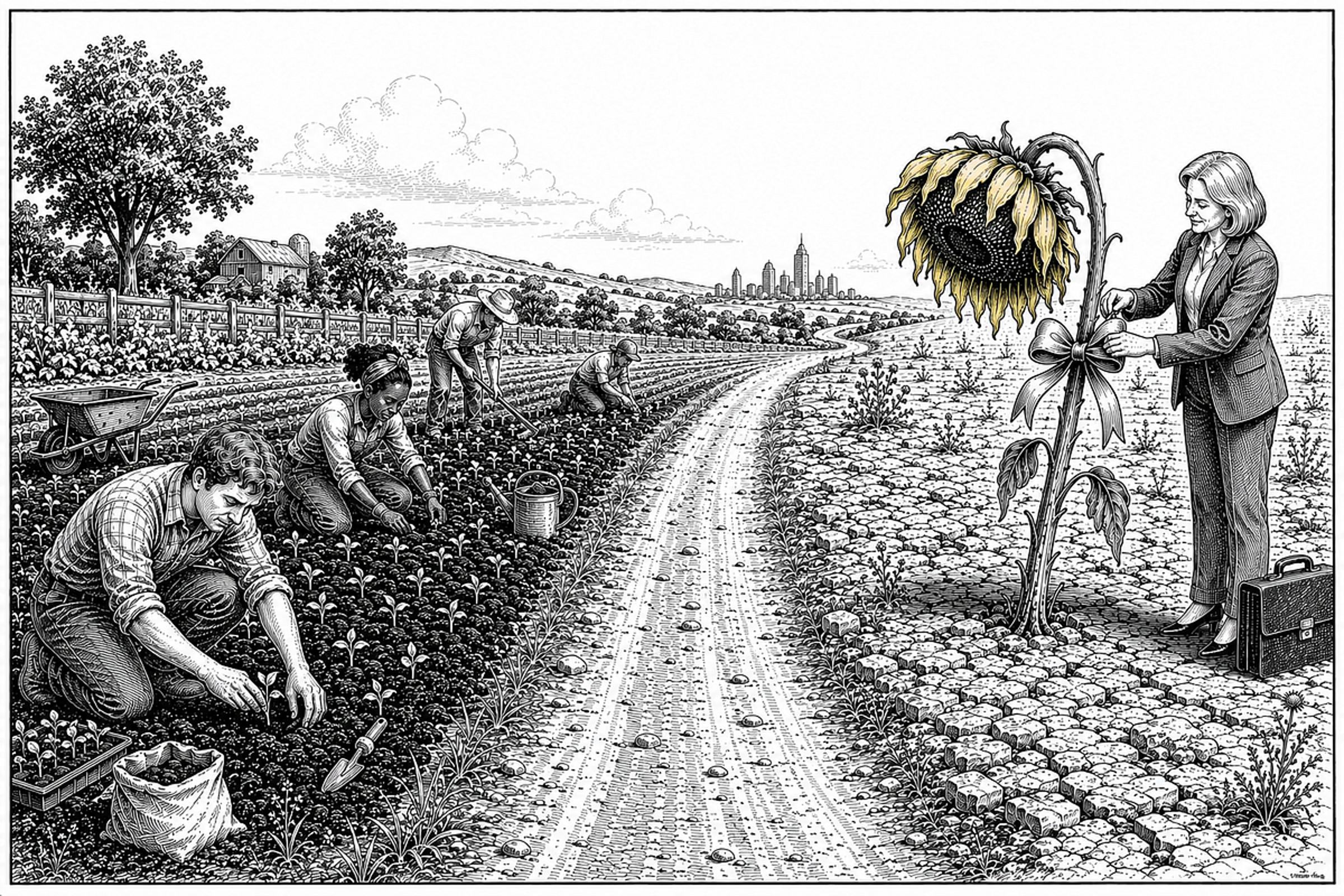
There is no version of this where you skip to August. Not a faster version, not a more expensive version, not a version where somebody who knows far more than I do does it on my behalf. Anyone can buy a bloom, of course. A florist will happily sell you a dozen sunflowers this afternoon, and they will be beautiful on the table, and in a week they will be in the trash. You could even stand one fully grown stalk in the middle of a bare field and tie a ribbon around it, and people driving past might slow down to admire it. It is still one flower in dry ground, and no amount of ceremony turns it into an acre of them.
You can buy a bloom. What you cannot buy is a field that blooms.
Although I have been tempted, I have resisted the soil metaphor for months because it is the kind of thing that gets printed on a poster and stops meaning anything. But standing in that field this summer, the mapping stopped being decorative and started being uncomfortably exact. The ground is the culture. Not a loose analogy for it. The same physics, mapping in three specific ways.
The first is the test. Nearly every organization I talk to has diagnosed a tool gap. Very few have diagnosed a ground condition, and the ground condition is almost never a tool. It is whether a program director can say out loud that something is not working without it costing her something. It is whether decisions get made where the information actually lives or three levels above it. It is whether anyone in the building has an hour to learn something that will not pay off this quarter. Those are testable. Almost nobody tests them, because unlike a technology assessment, the results implicate the people commissioning the study.
The second is the amendment, which is the part I grossly underappreciated in all of my research before deciding to plant the field. Everything I added to that ground, I added before the seed went in. That was not a preference. It was the whole physics of the situation.
Nothing you add after the seed is in the ground ever reaches the seed.
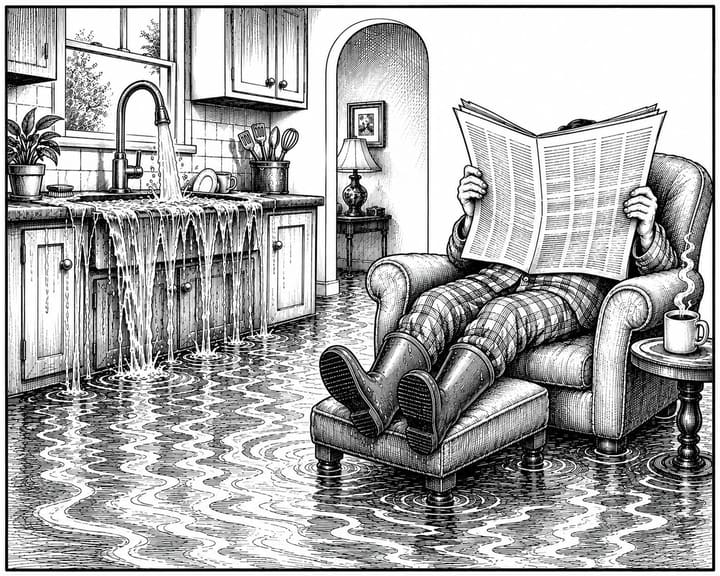
An organization that deploys a tool into a culture where people are afraid to admit what they do not know has not deployed a tool. It has installed an expensive new place for that fear to live. And the deployment does not fix the fear afterward. It hardens around it.
The third is the seeding itself. Ten thousand seeds, placed individually, because there is no broadcast setting for the thing I was trying to do. Too far apart and the stalks cannot support each other. Too close and they crowd each other out. Every serious culture change I have witnessed in twenty years in this sector moved the same way, one person at a time, at a pace that looks absurd on a Gantt chart and turns out to be the only pace available, and at a spacing that matters just as much: close enough that people hold each other up, far enough apart that each one has room to grow.
On another call this summer, at a very large organization, the head of IT offered what he clearly felt was the insight of the meeting. AI, he said, is something like a change management challenge.
My response came out before I had time to find a more delicate way to deliver it. It is not something like a change management challenge. It is the largest change management challenge your organization has ever faced, and probably the largest it ever will. Every technology transition your institution has survived, the database migration, the website rebuild, the move to the cloud, changed what people used. This one changes what people are for. Treating that as adjacent to change management is how organizations end up with an 85-point gap between adoption and impact and a genuine belief that they did the work.
It is late August now and the sunflower season is closing. The heads have gone heavy and the color is going out of the field, and I have been walking it most mornings taking notes and photos, which is not something I anticipated doing.
Here is what I have learned that I could not possibly have known in April. The sun crosses that field differently than I assumed. The rows are running the wrong direction. Next year they will run the other way, and the field will be bigger, and I will be making a set of mistakes I cannot currently name because I do not yet know enough to make them. That is the whole point.
The field does not have a completion date. It has seasons.
That is the half of this I did not fully appreciate. I had assumed preparation was a phase, something you complete and then graduate from into the actual work. It is not. I am standing at the end of a season I spent six months planning, holding a notebook full of things I will do differently, and next April I will prepare ground again with better information and a fresh inventory of what I do not know. There is no year in which I am finished learning how to do this, because the variables never hold still. The weather will be different. The insects will arrive on their own schedule. The birds will find the field, and so will the deer. The ground I finally came to understand this season is not the ground I will meet next spring.
Which brings me back to the call I said would come in 12 to 18 months.
It does come. It has come often enough that I can hear it starting in the first ten seconds. The shape is always the same. The project shipped. The money was spent. The firm delivered exactly what was on the statement of work, and by every measure written into the contract the engagement succeeded, the way cut flowers succeed. Then somewhere around month nine, people quietly went back to doing it the old way. The licenses are still being paid for. Almost nobody logs in. What the leader wants to know, usually in a careful voice, is whether the whole thing was oversold.
It was not oversold. The ground rejected the transplant. Every gardener learns this eventually. You cannot lift something that grew somewhere else, set it into soil nobody prepared, and expect it to take. The roots reach for what they need and find nothing there. The organization concludes that AI did not work for them, which is the most expensive wrong lesson available, because it is the one that stops the inquiry. The tool was never the problem. Nobody worked the ground, and the ground is the culture.
I have now worked on AI with several hundred of the largest nonprofits in the United States, and the pattern has repeated too often to keep calling it a coincidence. The organizations where it took were not the ones with the best tools or the biggest budgets or the sharpest vendors. They were the ones that did the unglamorous work before the project and, more to the point, kept doing it after.
AI is not a project your organization will complete. It is a condition your organization will operate in. It is an exponential technology, which in practice means the thing your policy was written for is not the thing sitting in your building six months later. Definitions expire faster than leaders update them. The capability that was a research demo in the spring is in your staff’s hands by fall, whether or not anyone decided it should be. An organization that treats this as a transition will finish the transition and find the ground has moved underneath it.
So the leaders who come through this are not going to be the ones who pick the right vendor. They are going to be the ones who stop asking when this will be done. In almost every presentation I give, I offer the same three truths about AI. You are never ready. You are never done. And today is the worst AI you will ever use. All three point to the same conclusion: the work is never complete. There is a season, and then there is the accounting, and then there is a harder season with more ground in it, and that is not the bad news. That is the job now.
So when I ask about the culture, it is not a rebuke and it is not an argument against the projects. Both firms on that leader’s desk were competent. Either one would probably have delivered what it promised. The proposals were never the variable.
Pick one. Execute it well. Then go do the culture work nobody is asking you about, and keep doing it long after the project has been declared finished, because the project will be finished and this will not be.
Everyone will ask you about the flowers. They always do. But nothing standing ten feet tall in August was planted in August, and nothing standing there next August is being decided by anyone who thinks they are already done.
About the Author
Nathan Chappell, MBA, MNA, CFRE, AIGP is Chief AI Officer at Virtuous Software and co-author of Nonprofit AI, The Generosity Crisis and the forthcoming book, N1 Philanthropy. He writes about responsible innovation, the future of generosity, and the power of radical connection in the age of AI.
Originally published on Nathan’s Substack.