Shrug Philanthropy
The greatest threat to generosity is not distrust. It is the shrug.

July 9, 202615 min read
by Nathan Chappell
The Pond
On your way to work, you pass a shallow pond. A toddler has wandered into it and is struggling to keep her head above the water. You look around for a parent, a babysitter, anyone. There is no one. Saving her would be easy and safe. The pond is only knee-deep. But you would ruin the new shoes you bought last week, and you would be late for a meeting you cannot afford to miss.
What do you do?
If you have spent any time in an ethics classroom or a nonprofit conference hall, you know this story. The philosopher Peter Singer published it in 1972, in an essay called “Famine, Affluence and Morality,” and it has been unsettling students ever since. In 2023, I opened a keynote at the AWS Imagine conference with it, one of the first keynotes I gave after The Generosity Crisis was published, and I have returned to it in workshops and presentations many times since. It works every time, and it works for the same reason. The answer is unanimous. In fifty years of telling, across classrooms and conference stages and dinner tables, no one has ever raised a hand to defend the shoes.
Singer’s point was that distance should not change the answer. If you would wade in without hesitation to save the child in front of you, he argued, you cannot justify ignoring the child dying of a preventable disease on the other side of the world. In 1972, that argument had a specific job to do. Distant suffering was largely invisible. The moral challenge of the age was ignorance, and Singer’s task was to make people see what they could not see.
Singer won the argument and lost the behavior. Five decades of philosophy students have agreed that distance should not matter, and five decades of human conduct have demonstrated that it matters more than almost anything else.
But something else has changed since 1972, something the thought experiment never anticipated. The pond assumed a single child, a single morning, a single choice. It never asked what happens when you pass ten thousand ponds a day.
We are about to find out. In fact, I believe we already have.
The Market That Stopped Flinching
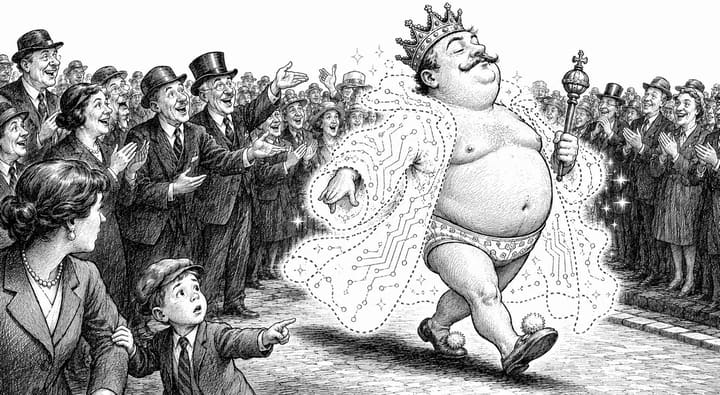
Last summer, when the United States struck nuclear facilities in Iran, analysts braced for the reaction that history said was coming. A direct attack on a major oil-producing nation in the world’s most volatile region has a script: prices spike, markets convulse, the world holds its breath. Instead, oil closed lower on the first day of trading afterward. The world’s most sensitive alarm system registered the event and, in effect, looked away.
This year, when strikes became a war, the pattern deepened in a way that should unsettle anyone who studies attention. Equity markets kept climbing while economists downgraded their forecasts. Measured volatility fell even as measured risk rose. Prices moved decisively only when the Strait of Hormuz physically closed and the barrels literally stopped arriving. I have no standing to argue what markets should have done, and this is not a column about the war itself. What interests me is the shape of the reaction. The market did not stop noticing conflict. It stopped responding to conflict’s meaning. Anticipation, implication, moral weight, second-order consequence: none of it moved the needle. Only physical interruption registered.
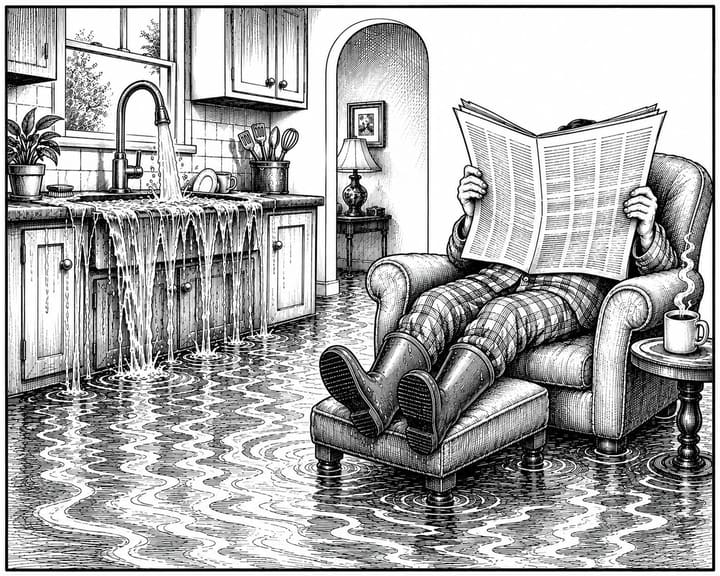
Financial writers have started calling this phenomenon shrug economics. The theory goes something like this: there is no longer one war but several, no longer one crisis but many, and the sheer volume of signal has exceeded any institution’s capacity to price it. When traders described their own reasoning, they sounded less like analysts and more like exhausted parents. The threatened catastrophe had failed to materialize so many times that the rational strategy became not reacting at all.
When everything demands a reaction, the most rational strategy is to stop reacting. That sentence should terrify anyone whose work depends on the human capacity to care about strangers.
Shrug Philanthropy
I work in a market too. It trades in something harder to quantify than crude oil, but it is a market all the same, with supply and demand, with signals and noise, with participants deciding every day what deserves their attention and what does not. It is tempting for those of us in the nonprofit sector to believe we are insulated from the forces reshaping the trading floor, that because we deal in meaning, we are exempt from the economics of attention. We are not. We are downstream of them.
Call it shrug philanthropy.
Consider what has happened to charitable participation in this country. In 2000, the same year I entered the nonprofit sector as executive director of my local Boys and Girls Club, two thirds of American households gave to charity. By 2018, the share had fallen below half for the first time since researchers began measuring, to 49.6 percent. According to the Generosity Commission, as many as twenty million households dropped out of giving between 2010 and 2016 alone. However, total dollars kept rising over the same period, propped up by larger gifts from fewer people, which is why the sector’s dashboards stayed green while its foundation quietly eroded. Researchers and consultants alike nonchalantly call it “dollars up, donors down.” I have come to think of it as the sound of twenty million shrugs.
The pattern did not pause for a new decade.
A few weeks ago, Giving USA reported that charitable giving reached $617.2 billion in 2025, crossing the $600 billion mark for the first time in American history. By the headline, it was the most generous year this country has ever recorded. Beneath the headline, the concentration deepened. Individuals now account for 64 percent of total giving, down from roughly 80 percent in the mid-1980s and near the lowest share ever measured.
The year I entered the sector, Americans gave 2.4 percent of their disposable income to charity. Last year, the figure was 1.7 percent. And of the $19.2 billion in megagifts from individuals in 2025, a full third came from a single donor, MacKenzie Scott. Her generosity is genuinely extraordinary. But a record built on fewer and fewer deciders is not the same thing as a generous nation. As I argued in The Generosity Crisis, a philanthropy that concentrates is a philanthropy that becomes less democratized. When giving flows through a shrinking number of hands, the needs those few can see become the needs that get met, and everyone else waits.
The comfortable explanations are real but insufficient. The Great Recession damaged household balance sheets. Institutional trust declined. Religious affiliation, long the front door to giving, weakened. Yet when researchers at the Indiana University Lilly Family School of Philanthropy examined the decline, they could attribute just over a third of it to shifts in income, wealth, and homeownership. The majority of the collapse traces to something economics cannot fully name.
There is a possibility the sector has been reluctant to consider. What if millions of those households never decided anything at all? Not distrust. Not disillusionment. Not a verdict on our effectiveness or our overhead ratios. What if they simply never got past the shrug, because doing nothing has never been easier, and considering everything has never been harder?
I received an unintended confirmation the same day the Giving USA report came out. A colleague I have known and worked with for the better part of two decades sent me her summary by text: déjà vu, same news as always, nothing that would help her inspire more people toward goals that climb higher every year. She was not wrong, and that is precisely what unsettled me. The sector’s most comprehensive annual diagnosis has become background noise to the very professionals whose job is to answer it. The drumbeat of record dollars and disappearing donors has sounded for so long that even the people inside the data have stopped flinching at it. The shrug is no longer just a description of our donors. It is becoming a description of us.
Ten Thousand Ponds
In 1971, a year before Singer described his pond, the economist Herbert Simon issued a warning that reads today like prophecy. In a world flooded with information, he observed, the scarce resource would no longer be information itself. A wealth of information creates a poverty of attention. Two professors, twelve months apart, at the dawn of the information age: one assumed human attention would be available when the moment demanded it, and the other predicted its depletion. We have spent fifty years proving the second one right.
The evidence is now overwhelming, and it extends far beyond philanthropy. The Reuters Institute’s global study of news consumption found that forty percent of people across forty-eight countries now sometimes or often actively avoid the news, up from twenty-nine percent in 2017. Their reasons are not apathy in any classic sense. They cite the toll on their mood. They cite feeling overwhelmed. And roughly one in five cite something more haunting: powerlessness, the sense that there is nothing they can do with what they learn. That last reason is the shrug in survey form.
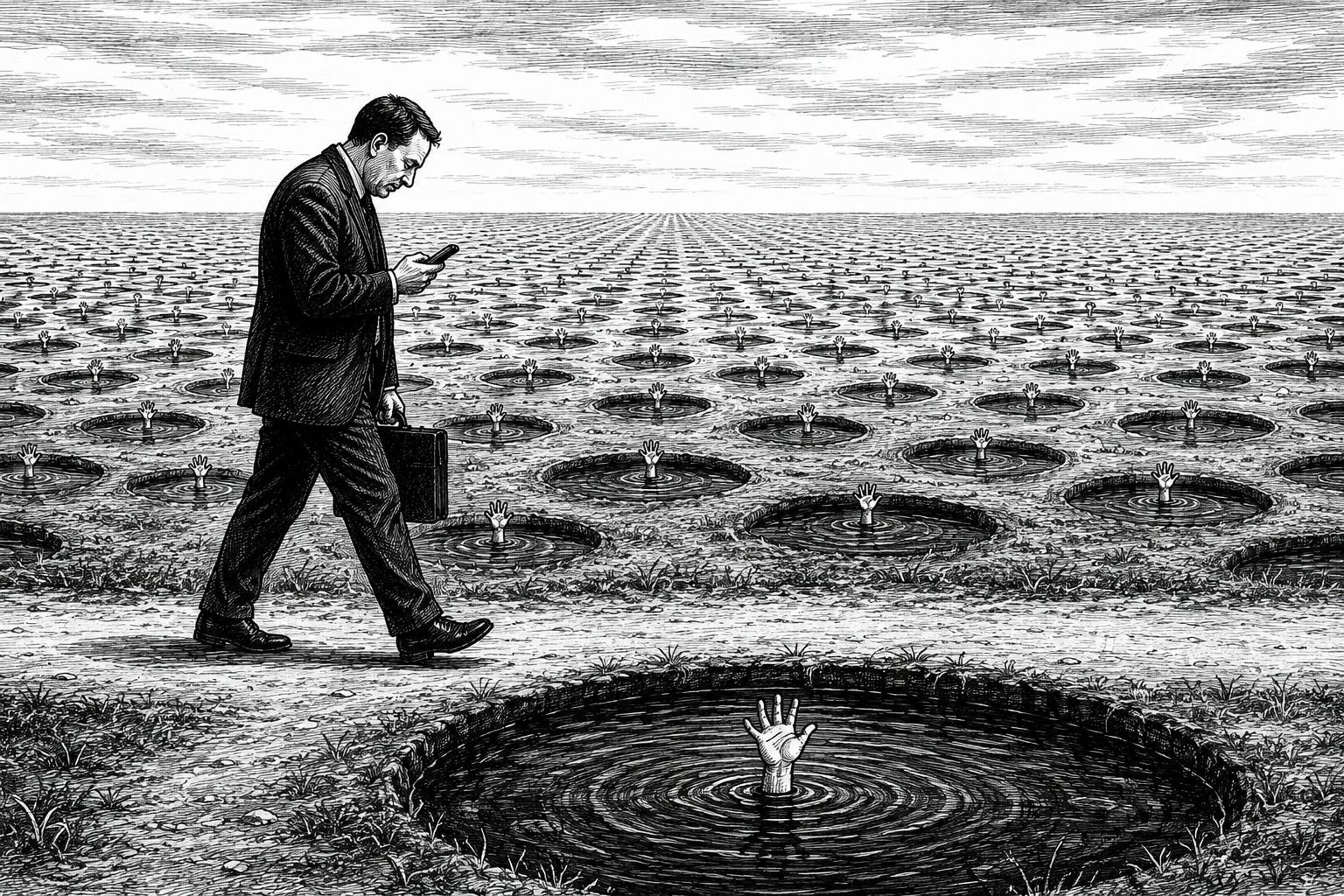
It is a person standing at the edge of ten thousand ponds, concluding that wading into just one of them could never matter, and walking on past them all.
The psychologist Paul Slovic has spent decades documenting what he calls psychic numbing, and his findings invert our intuitions about compassion. We assume that as suffering grows, concern grows with it. The research shows the opposite. A single identifiable child moves us more than statistics describing millions, and our willingness to help begins declining as soon as the number of victims climbs past one. Slovic titled one of his papers with the finding itself: the more who die, the less we care. Compassion, it turns out, does not scale. It was never designed to.
None of this evidence describes a generation worse than the ones before it. It describes people asked to carry more awareness than any humans in history, who have responded the only way a finite mind can: by skimming across the surface, sampling the high-level signals, and picking a defensible position somewhere in the middle. The shrug is not a moral failure. It is a coping architecture.
But architecture has consequences, and ours has collided with a sector built on the opposite assumption. There are nearly two million registered nonprofits in the United States, and virtually every one of them is raising its voice. Our collective response to declining attention has been volume: more email, more appeals, more urgency, more everything. We are trying to out-shout the shrug. And the shouting feeds it.
The U-Turn
I would rather diagnose this in others, but honesty requires a confession.
A few years ago, I was pulling off a highway, running late for a meeting, when I stopped at a light where a man stood asking for financial help. I did what I suspect most of us have done. I pretended not to notice. I studied the traffic signal with sudden fascination, and when it changed, I drove on. I made it about a block. Then the nagging feeling arrived, the one that always seems to travel a beat behind the eyes: that was a real person, with a real need, and I had looked through him like weather. I made a U-turn, drove back, and gave a stranger what I could.
I would love to tell that story as evidence of my character. It is closer to evidence of the opposite. The honest version is that my first response was the shrug, and my conscience needed a full city block to catch up. I think of the times it never did. The cars I have passed on the shoulder while assuring myself a tow truck was surely minutes away. The appeals I have scrolled past while telling myself someone closer to the problem would respond. The shrug does not announce itself as a decision. It arrives disguised as a schedule.
The shrug is not the absence of conscience. It is a delay in it. And in an accelerating world, the delay usually wins. The light changes. The feed refreshes. The moment passes, and no U-turn presents itself.
Crisis by Consent
There is a reason this pattern feels personal to me, and it reaches back to the same remarkable window when Simon and Singer were writing.
In 1973, my grandfather published a book called Crisis by Consent. Its thesis has followed me my entire career: the gravest dangers a society faces come not from people who refuse to help, but from people who never pause to consider whether they should.
Crisis does not require malice. It only requires our consent, and we grant that consent through inattention, one unconsidered moment at a time.
He wrote those words before the internet, before the smartphone, before most of us started scrolling 300 feet per day on average. He could not have imagined a world in which the average person encounters more human suffering before breakfast than his generation confronted in a month. And yet he named the mechanism precisely. Those twenty million households did not refuse to give. Refusal requires consideration, a weighing, a verdict. They consented to a quieter crisis by never reaching the question at all.
That distinction matters enormously for what the nonprofit sector does next. If the problem were refusal, the answer would be persuasion: better arguments, better evidence, better campaigns. But you cannot persuade someone out of a question they never asked. The shrug sits upstream of persuasion entirely. Which raises the only question that matters: what actually breaks one?
What Breaks a Shrug
In the spring of 2020, I read an article that got my attention in an unexpected way. It described a paradox so sharp it bordered on the absurd: families waiting in lines that stretched for blocks outside food banks, while a few hundred miles away, farmers plowed perfectly good crops back into their fields because the systems that moved food had seized up. Harvests that had taken a year to grow were being destroyed within driving distance of people who had waited hours to feed their children. A group of college students, home on a break nobody had planned, decided the distance between those two facts was drivable. They rented box trucks and U-Hauls, picked up the food themselves, and delivered it to the food banks. That improvised convoy became The Farmlink Project.
What that story exposed in me took longer to admit. By 2020, I had spent two decades working alongside thousands of charities. I knew the sector’s machinery from the inside. And in all that time, I had never once sent the email that fundraisers dream about, the unprompted note from a stranger that says: I am moved by what you do, and if there is anything I can do to help, tell me. That day, I wrote it. And recieved a grateful response the following day. Eventually I joined Farmlink’s board, where I have watched a charity born in a dorm-room-sized moment of conviction defy every odd stacked against a startup nonprofit. In its most recent fiscal year, Farmlink moved 136 million pounds of food, bringing its total to half a billion pounds since its founding, while preventing 117,000 tons of CO2e from entering the atmosphere and saving four billion gallons of agricultural water.
For a long time I assumed that story broke through to me because the need was so great. But I had encountered greater needs professionally every week for twenty years. The need was not greater. It was closer. The paradox gave it a shape my attention could not skim past: real fields, real trucks, real families in a line I could picture down to the folding tables.
I could picture it because, as a child, I had stood in one myself. The story did in an instant what no statistic had done in two decades. It made the people in that line visceral to me, and the shrug I did not even know I was holding gave way.
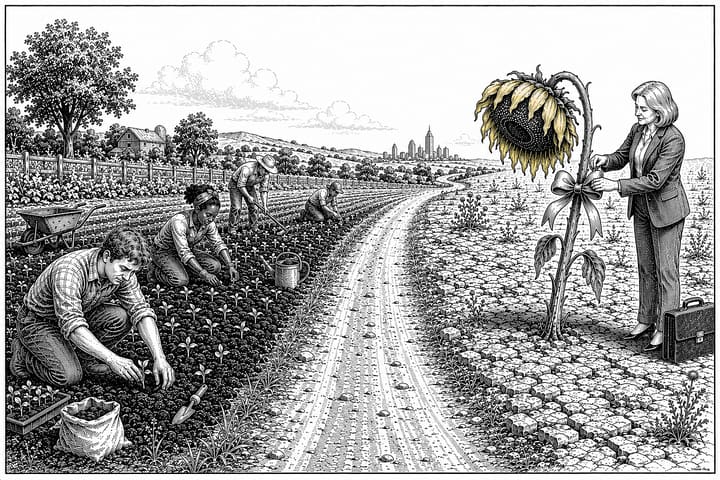
Shrugs are not broken by louder appeals. They are broken by closer ones.
All of this points to an uncomfortable reckoning for my profession. For roughly the last quarter century, fundraising has moved in exactly the opposite direction: from the relational to the transactional, from the individual to the segment, from the neighbor to the list. We industrialized the ask during the precise decades when attention was collapsing, and we should not be surprised that industrial appeals are what the shrug was built to absorb. The market stopped responding to meaning and now responds only to proximity. Generosity works the same way. Relevance at the level of a single human being is not a nice-to-have in an attention crisis. It is the only signal that still gets through.
That conviction sits at the heart of N1 Philanthropy, the book Gabe Cooper and I will release on October 14, which argues that the future of generosity will be built one person at a time rather than one segment at a time. But you do not need a book to test the premise. You have already tested it on yourself.
Think of the last time you gave, really gave, unprompted. I would wager it was not a campaign that moved you. It was a face, a story, a line you could picture, a pond you could see.
The shrug survives on invisibility. It does not feel like a decision while it is happening. It feels like a schedule, a scroll, a reasonable allocation of limited time. But a shrug you can see is a shrug you can refuse. I know the feeling of mine now. It feels like the block of road between the traffic light and the U-turn, the small delay between noticing and caring. Naming it has not made me wade into every pond, and it should not. Trying to care about everything is precisely the burden that produced the shrug in the first place. What awareness restores is the thing my grandfather warned we were losing: not the obligation to act every time, but the willingness to consider. In practice, it looks like deciding in advance that the nagging feeling deserves the U-turn. It looks like standing beside a few ponds instead of scanning ten thousand. It looks like letting one story get close enough to cost you something.
When the FarmLink article finally got through, I did not have to talk myself into responding. The instinct fired instantly, twenty years of professional restraint notwithstanding. That is what the research on generosity keeps finding, and it is the conviction underneath everything I have written on this subject.
The impulse to give is not fragile or fading. It is ancient, biologically hardwired, and intact. The shrug buries it. It has never once erased it. Which means the crisis in front of us is not a generosity deficit at all.
It is an attention deficit resting on top of an instinct that has been waiting, the entire time, for something close enough to wake it.
Singer’s question, it turns out, was never really whether you would save the child. Everyone saves the child. Fifty years on, in a world of ten thousand ponds, the question has changed into something he never had to ask: whether you would notice her at all. The toddler is still in the water. The water is still only knee-deep. And the first act of generosity, before the wallet ever opens, before a single shoe gets wet, is refusing the shrug long enough to look.
Generosity begins where the shrug ends.
Nathan Chappell, MBA, MNA, CFRE, AIGP is Chief AI Officer at Virtuous Software and co-author of Nonprofit AI, The Generosity Crisis and the forthcoming book, N1 Philanthropy. He writes about responsible innovation, the future of generosity, and the power of radical connection in the age of AI.
Originally published on Nathan’s Substack.