The Emperor's New Operating System
The nonprofit sector has learned to describe AI fluently. That is exactly the problem.

July 21, 202610 min read
There is a version of the story most people misremember. They remember the ending. A child in the crowd, the naked emperor, the laughter that spreads down the parade route. What they forget is the middle, which is where the real machinery lives.
Two weavers arrive in the city and promise a fabric so fine that it is invisible to anyone unfit for their office or hopelessly stupid. The emperor, who is vain, commissions a suit. He sends his most trusted minister to inspect the work, and the minister, standing before the empty looms, sees nothing at all. The minister does not conclude that the cloth is absent. He concludes that he himself must be the fool. So he reports back that the weaving is magnificent, the colors extraordinary, the pattern like nothing he has ever seen. A second official goes, sees nothing, and lies for the same reason. When the emperor finally goes to see the cloth for himself, he sees nothing too. And he draws exactly the same conclusion everyone else did.
It is easy to assume the ministers lied while knowing better. Some of them did. But the more human and more troubling possibility is that many of them talked themselves partway into belief. Stand in front of an empty loom long enough, with everyone around you praising the weave, and you begin to describe colors you cannot see. You learn the vocabulary of the fabric. You become fluent in a thing you do not understand. That is not deception aimed at others. It is deception that has turned inward, and it is far harder to break, because the person doing it no longer knows there is anything to break.
That is the engine of the story. Not the weavers’ con. The court’s fluency.
I keep returning to this fable because the nonprofit sector is the court right now, and the fabric is artificial intelligence.
Nine in ten nonprofits will tell you they are using AI. I believe them. That is what worries me.
The adoption research my colleagues and I have spent years compiling keeps returning a gap that ought to stop people cold, and mostly does not. Roughly ninety percent of nonprofits now report using AI in some form. Something closer to seven percent report that it has produced meaningful, mission-level impact. Most people hear that gap and assume it is a problem of access, or budget, or technical skill. It is not. The tools are cheap and getting cheaper, and the sector is using them. The gap lives somewhere else entirely. It lives in the difference between using a thing and understanding what the thing is.
Listen to how organizations talk about their AI adoption and you will hear the ministers describing the cloth. We use it for drafting appeals. We use it for donor research. We use it for meeting summaries. Our team is trained. Our policy is approved. Every sentence is true, and every sentence is fluent, and the fluency is the problem. Because fluency with AI has been quietly mistaken for comprehension of its capabilities. People use the tools every day, describe their usage confidently, report it on the surveys, and mistake the describing for the understanding. They have learned the vocabulary of the fabric. Whether they can see what is actually on the loom is a different question, and almost no one has been asked it.
I wrote recently that AI is not what you think it is. This essay is the fable version of that argument, because Andersen understood something about collective misperception that a research report cannot quite deliver. The court was not wrong about the details. The ministers could describe the colors. They were wrong about the thing itself. And a sector can be wrong about the thing itself while getting every detail of usage right.
Here is the misconception.
The sector has been led to believe that artificial intelligence is a set of tools. Tools you evaluate, procure, deploy, and train people on. Tools that accomplish specific tasks. Draft the letter. Score the donor file. Summarize the meeting. This belief is comfortable because it is how every previous technology worked, and it is wrong, because AI is not a new tool. It is closer to a new operating system for how work gets done at all.
The difference is not semantic. Think about what a tool is. A tool is something you pick up, use for its task, and set down. It waits for you. It does its one thing. The organization around it stays exactly what it was. A word processor is a tool. A scheduling app is a tool. You learn it once, and it stays learned.
An operating system is a different category of thing. You do not pick it up and you do not set it down. It is not visible, and it does not do one task. It is what everything else runs on, and when it changes, everything running on it changes, quietly, underneath, everywhere at once. An organization that treats AI as a set of tools asks which tasks to automate. An organization that treats AI as an operating system asks a different question entirely: how does the capability of every single person in the building change when the work itself runs on something new?
The ninety percent are answering the first question, diligently and in good faith. The seven percent are answering the second. That is the whole gap. The organizations reporting real, mission-level impact are not the ones with the most impressive individual use cases. They are the ones who stopped thinking about AI as a set of tools to achieve certain outcomes and started raising the capability of the entire organization, every person, every function. A use case improves one activity. An operating system improves the person doing all of them.
And the misconception is getting more expensive by the month, because the thing itself will not sit still.
A tool is a thing you learn once. You come to understand a word processor, and then you understand it, and it stays understood. But researchers at METR have been measuring something that does not hold still long enough to be learned that way. The length of tasks these systems can complete on their own has been doubling roughly every seven months, and lately closer to every four. Follow that line outward and it points toward agents handling a full day of work with only a review at the end, somewhere around May 2027, and far longer stretches in the months just after. The researchers are careful about this, and so am I. The trend may slow, and the tasks they measure are not the whole of anyone’s job. But the direction is the point.
This is what makes the tool misconception so costly. A tool can be adopted and understood. A thing that doubles its reach every few months cannot be adopted in any final sense, because the thing you adopted in January is not the thing running in October. What the ninety percent believe they have mastered is being rewoven under their hands faster than they can perceive, and they are praising its colors anyway. The confident usage report, the approved policy, the completed training, these are descriptions of a fabric from two doublings ago. The false confidence is more dangerous than the earlier hesitation ever was, because hesitation at least keeps asking questions.
Fluency stops asking. Fluency already knows.
Now the ending of the fable, which is stranger than most people remember.
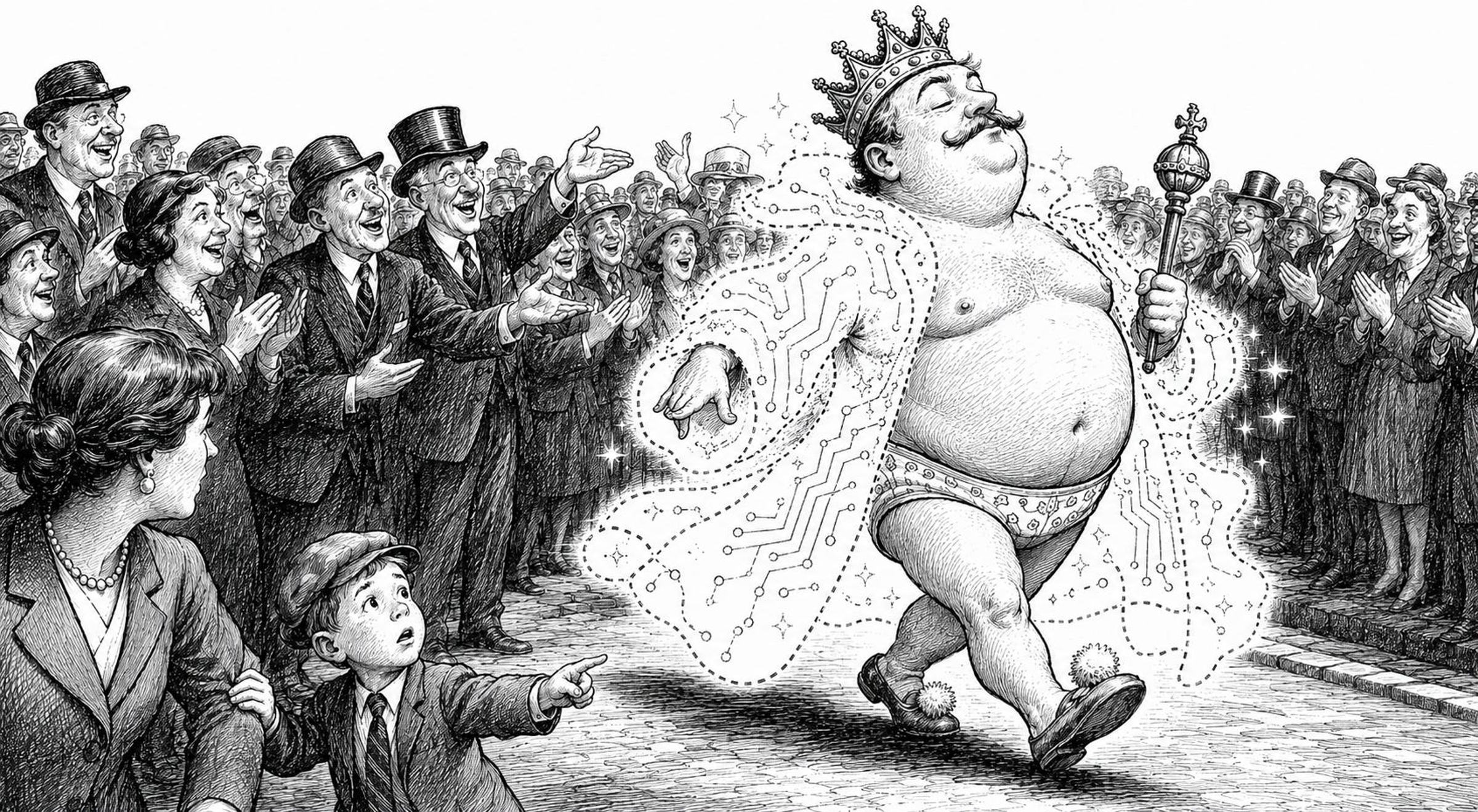
We tend to recall the child’s voice as the moment the spell breaks. The boy says the emperor is wearing nothing, the truth spreads through the crowd, and the illusion collapses. But read what actually happens next. The whisper does spread. The people do begin to murmur that the child is right. And the emperor hears it. He suspects they are correct. And he holds himself even prouder and finishes the procession anyway, because the alternative, stopping mid-parade and admitting the whole thing was empty, is more humiliating than walking the rest of the route in his birthday suit.
That ending describes the sector more precisely than the child’s line does. Even collective recognition does not stop the machine. Plenty of leaders privately suspect that their AI adoption has not changed much of anything. The usage is real, the impact is thin, and somewhere in the back of the mind a small voice has already said so. And the procession continues anyway, because there is a board expecting a report, and a policy already approved, and a survey response already submitted, and the humiliation of saying we do not actually understand this yet is worse than the cost of continuing to describe the colors. Momentum has its own logic, and it is not the logic of what is true. It is the logic of what is already in motion.
So what breaks the spell.
Not more usage. Usage is what built the fluency in the first place. And not another tool evaluation, because evaluating tools is the misconception performing itself.
In the fable it takes a child, someone too young to have learned the fear. Organizations do not get to hire children. What they have instead are leaders, and a leader can do the child’s work by doing the one thing no minister could bring himself to do.
Say it out loud, first: I do not understand this yet. Remember what powered the con. Every person in that court believed that admitting confusion would mark them unfit for their office, so every person performed a comprehension they did not have, and the performance became the culture.
One sentence from the top dissolves it. The moment a leader says I do not understand this yet, the admission stops being disqualifying and becomes the standard. The whole room is suddenly allowed to look at the loom instead of describing it.
In my experience the relief is immediate and almost audible, because most of the people in that room have been privately carrying the same sentence for a year.
The second thing is to treat understanding as perishable. Not wrong, perishable, the way a carton of milk is not wrong, it is dated. A definition of AI written eighteen months ago describes a fabric from three or four doublings back. So the honest question is not what is this thing, asked once and answered. It is what is this thing now, asked on a cadence, the way a finance committee reviews the numbers quarterly without anyone taking it as an insult to last quarter. The organizations in the seven percent are not smarter. They have simply stopped expecting the answer to hold still, which means their confidence renews instead of calcifies.
You cannot finish learning a thing that refuses to hold still.
That is the child’s question, in the end. Not the cynic’s version, which is whether AI is real. It is real, and the seven percent are proof. The child’s question is quieter and harder: what is actually on the loom? Not what do we use it for. Not what does our policy say. What is this thing, actually, and is it what we have been describing all along? A leader who sits with that question honestly will notice the gap between their fluency and their comprehension, and noticing that gap is the beginning of everything. It is, not coincidentally, the posture of curiosity the sector keeps being told it needs, applied to the one subject where confidence has quietly replaced it.
The emperor’s mistake was never commissioning the suit. It was believing he understood what he had commissioned, and then walking out the palace doors on the strength of that belief. The sector has commissioned the suit. The procession is forming. The only question left is whether we will keep describing the fabric, or finally look at the loom.
Nathan Chappell, MBA, MNA, CFRE, AIGP is Chief AI Officer at Virtuous Software and co-author of Nonprofit AI, The Generosity Crisis and the forthcoming book, N1 Philanthropy. He writes about responsible innovation, the future of generosity, and the power of radical connection in the age of AI.
The METR time-horizon research referenced above: https://theaidigest.org/time-horizons
Originally published on Nathan’s Substack.