The Article I Kept Not Writing
What my grandfather understood about apathy, and what it has to do with the energy behind every AI prompt

June 25, 202622 min read
My grandfather was a geologist. He earned his doctorate studying the earth, spent part of his career with the Atomic Energy Commission, and worried, more than almost anything, about water. Not in the abstract. He worried about what we would leave in the ground and the rivers for people who had not been born yet, and whether anyone would think to ask before it was too late to matter.
In 1973 he wrote a book about it. He called it Crisis by Consent. I reread it this past weekend, slowly, the way you read something written by someone you loved who is no longer here to argue with you about it.
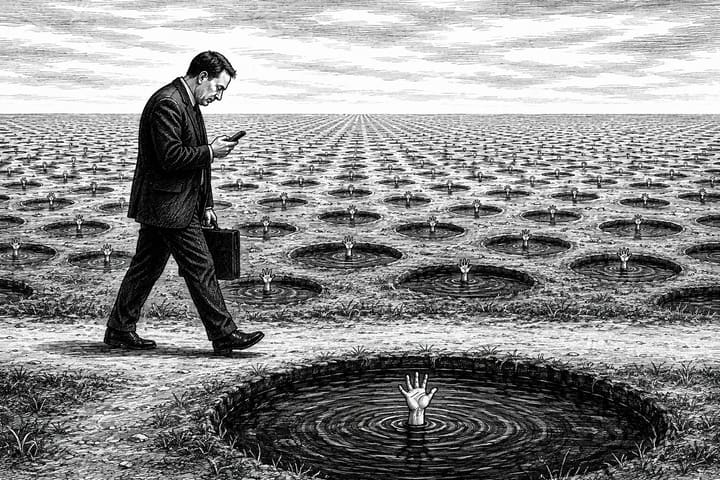
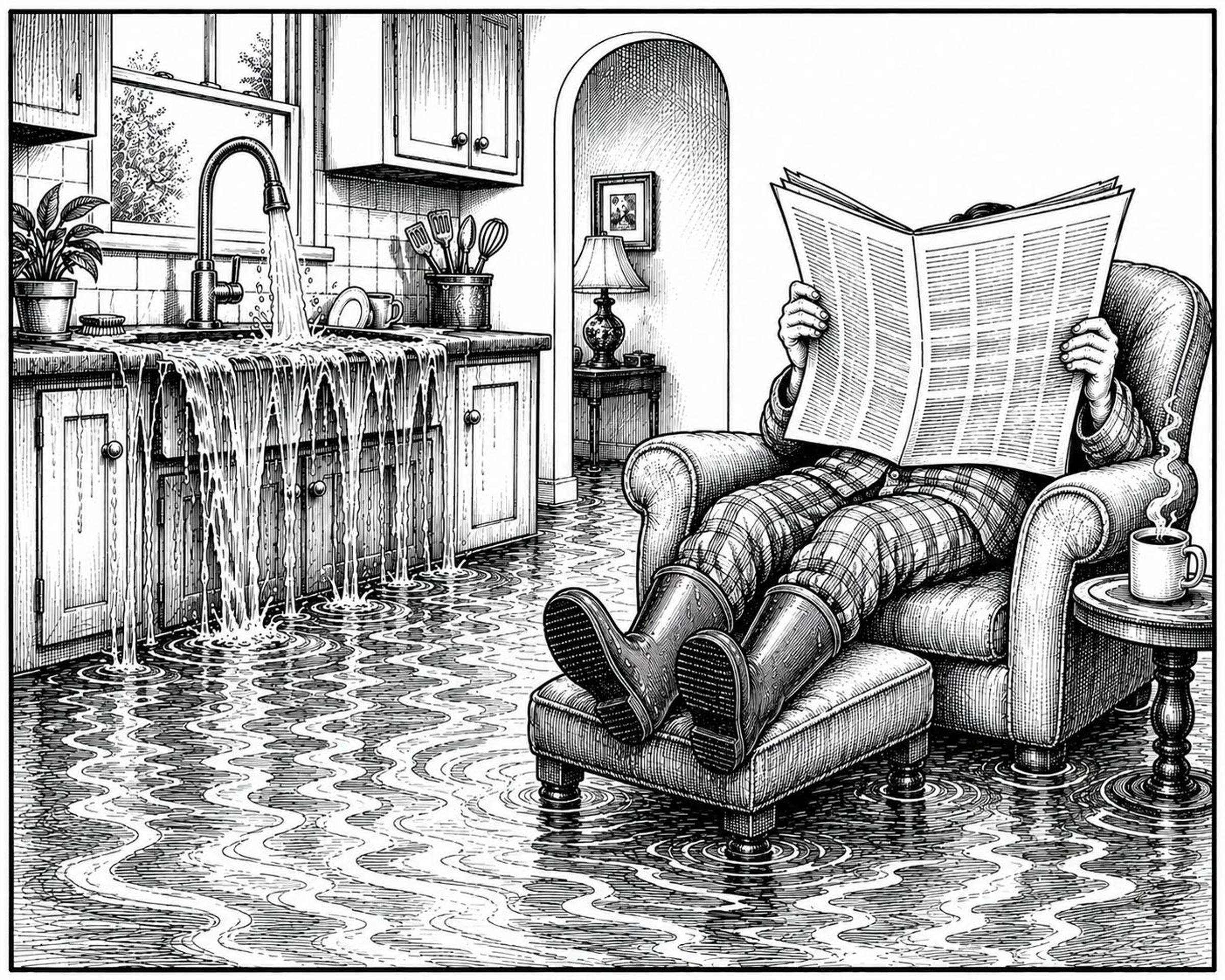
The title is the argument. He did not believe our gravest danger was the villain who sets out to do harm. We can see that person coming. We organize against them. His fear was quieter and, he thought, far more dangerous: the person who never considers whether they should act at all. The one who lets it happen. Not through malice. Through the simple failure to ask the question. A crisis, he argued, rarely arrives by force. More often we consent to it, one unexamined decision at a time.
I have carried that idea my whole life. It runs underneath most of what I believe about generosity and about technology. And it is the reason I have to begin this particular article with a confession.
I have been avoiding writing it for over a year.
I keep a running journal of pieces I feel compelled to write. This one has sat at the top, untouched, longer than anything else on the list. Every time I reached for it, I found a reason to set it down. Too divisive. Too political. Too easy to be misread as carrying water for an industry I am part of, or as scolding the people I work alongside. I’ve worked with many environmental organizations. I admire them. I did not want to hand anyone a weapon, and I did not want to write something that would age into embarrassment as the facts moved underneath me.
Those were my reasons. They were also, I have come to see, exactly the kind of reasoning my grandfather was warning about. Avoidance dressed as prudence. Silence that feels responsible from the inside. I was not refusing to engage with the hardest question my field is asking right now. I was simply, politely, declining to consider it. Consenting, in his sense of the word.
So this is me, finally asking the question.
The Question Behind the Question
I deliver something like five webinars a week. I have learned to expect, almost without fail, that one of the first questions afterward will be about the environment. What about AI’s energy use? What about the water? Should we feel guilty about this?
For a long time my honest internal reaction was a kind of flinch, because the question is usually aimed at the wrong target. The person asking is almost always thinking about their own prompts. Their own usage. Whether the email they just drafted with AI cost the earth something. And on that narrow question, the math is not close.
For some perspective, a single typical AI prompt uses roughly 0.3 watt-hours of electricity. That figure comes from Epoch AI, an independent research group, and it is about a tenth of the alarming number that circulated a couple of years ago, before the models and chips grew far more efficient. To put 0.3 watt-hours in perspective, it is less than an LED bulb draws in a few minutes. The water involved is a fraction of a teaspoon. Meanwhile the average American moves through a day of streaming, scrolling, commuting, and cooling a house that consumes on the order of tens of thousands of watt-hours, without a flicker of guilt. If you want to shrink your footprint, skipping a prompt is like trying to lower the ocean by declining a glass of water. Longer and more complex queries cost more, and the picture shifts as usage grows. But for the individual worried about a single email, the math is not close.
I grew up, as I said, in a household shaped by a man who studied water. You turned off the faucet while you scrubbed. You kept showers short. You did not waste what others would need. It was not only water. You never left a light on unless you needed it to see. We ran fans instead of air conditioning. Conservation was not a cause in our house; it was just how you lived, a kind of daily respect for things that were not infinite. I carry that instinct still, and I think it is a good one. But I have watched that same instinct get pointed at a 0.3 watt-hour prompt by someone holding a phone that streams hours of video a day, and aimed there, I have come to believe it does more harm than good. It spends our limited capacity for concern on the one thing that barely registers, and leaves nothing for the things that matter enormously.
Here is what I have learned to say instead, gently, because the question is sincere even when it is misaimed: the size of your individual prompt is the least interesting thing about AI and the environment. The interesting questions, the genuinely hard ones, live one level up. And they are much harder than the people asking me have usually been told.
The Number That Should Hold Your Attention
Step back from the single prompt and the picture changes completely.
Data centers consumed somewhere around 415 terawatt-hours of electricity in 2024 and surged by roughly 17 percent in 2025, at a time when overall global electricity demand grew only about 3 percent. The International Energy Agency expects data center consumption to roughly double from its 2024 level by 2030, reaching something close to the total electricity use of Japan, with AI as the most important driver of that growth. The five largest technology companies poured more than 400 billion dollars into infrastructure in 2025 alone, and the IEA expects that figure to climb another 75 percent in 2026. To put it in proportion, the IEA has noted that the capital spending of just those few companies now exceeds global investment in oil and natural gas supply.
Those are not numbers most of us can absorb on first reading. We are building, in the span of a few years, an energy appetite the size of a major industrial nation, and we are doing it faster than any electrical grid was designed to absorb.
There is also a distinction the loudest arguments on both sides tend to flatten: not all of this is AI.
Data centers are not new. They have been growing for two decades. Every video you stream, every file in the cloud, every card you swipe and message you send already lived in a humming building somewhere drawing power. AI did not create that hill. What AI does is make the slope dramatically steeper. The specialized chips that run AI can draw several times the power of conventional server processors, and the most intensive facilities now under construction are projected to consume as much electricity as a small city. So when you hear that data centers are straining the grid, the truth is layered: the digital life we already built was energy-hungry, and AI is now pouring fuel on a fire that was already lit. Blaming AI for all of it is wrong. Pretending AI changes nothing is worse.
Then there is the matter of efficiency, which most people get exactly backward.
Why Getting Better Has Not Meant Using Less
In early 2025, an open-source model from China called DeepSeek arrived and stunned the industry by matching far more expensive systems at a fraction of the training cost. Many people read it as good environmental news. Efficiency had come. The machines would sip rather than gulp.
The open-source and Chinese part matters beyond energy. Data run through such a model can flow through servers governed by another country’s laws, with privacy implications very different from what most donors or beneficiaries would assume. That is a separate conversation, but not a small one, and the power bill was never the only interesting thing about DeepSeek.
On the energy question, the history is instructive. In 1865 a British economist named William Stanley Jevons noticed something that has never stopped being true. As steam engines grew more efficient, England did not burn less coal. It burned more. Cheaper power did not reduce demand; it unleashed it. Lower the cost of a thing and the world finds vastly more uses for it, faster than the savings can keep up. Economists still call it the Jevons Paradox.
When DeepSeek’s efficiency made headlines, the natural expectation was that the big spenders might ease off. They did the opposite. Meta’s leadership publicly dismissed the idea that its AI spending would fall, and across the industry the major labs reaffirmed and then raised their investment plans. Efficiency did not cool the race. It widened the prize, and everyone ran harder.
The deeper trend is staggering in its own right. The computing power used to train frontier AI systems has grown roughly four to five times every year for more than a decade, according to Epoch AI, an astonishing rate of increase by any historical standard. The chips themselves keep getting smaller and more capable per watt at a pace that would have seemed like fantasy a few years ago. And yet total consumption keeps climbing, because every gain in efficiency is immediately spent on something more ambitious. We are not pocketing the savings. We are reinvesting them, instantly, at scale. The path of energy and compute does not run in a straight line. The hardware and the algorithms grow more efficient, and the ambition grows right alongside them to consume whatever the efficiency frees up.
And a model is never finished. We tend to picture the enormous cost of training as a one-time event, like pouring a foundation. But the ongoing work of tuning and refining a deployed model has grown to rival the cost of building it in the first place. There is no moment when the engine is built and the burning stops. The energy required is not a purchase. It is a subscription, and it renews forever.
Building Faster Than We Can Ask Why
If you ask why we are building so far ahead of what today’s workloads require, the honest answer is not demand. It is fear.
The race to build bigger and faster has less to do with measured need than with the terror of being left behind. No major player can afford to assume a competitor will not build, so everyone builds, and the result is an infrastructure boom running well out in front of the actual work there is to do. This is not a conspiracy. It is what competition looks like under deep uncertainty. But it means the scale of what is being constructed reflects strategic anxiety as much as genuine necessity, and that is a different thing to consent to than a clear-eyed response to human need.
And consent is exactly the right word, because someone is always being asked to consent, whether or not they are actually asked.
I think about Nashville in part because a year and a half ago I moved to Middle Tennessee, and what is happening just up the road is not a case study I pulled from a news feed. My local news is saturated with it. It has become a conversation at the barber shop and in the grocery line, among the people who live here. This past June, two proposed data centers, one beside the Nashville Zoo in South Nashville and one on the campus of Fisk University in North Nashville, drew more than 150 residents to a single planning commission meeting. People waited up to five hours for two minutes at the microphone. A petition against the project near the zoo gathered more than 400,000 signatures. The mayor signed an executive order directing the city to study how large data centers affect surrounding neighborhoods, and the Metro Council advanced a temporary moratorium on new data center permits. What made the room furious was not only the noise and the water and the power draw. It was that both sites sit in historically Black and immigrant neighborhoods, communities that have absorbed this kind of thing before and were being asked, once again, to host the costs of a benefit flowing mostly to others. I am close enough to see this clearly. I am also not the one being asked to pay the highest price for it, and I want to be honest about that too.
In Louisiana, Meta’s Hyperion campus in Richland Parish is rising on land where residents say the deal was finished before they understood its scale. ‘There was no community input,’ one told Bloomberg. ‘It was a done deal.’ Longtime residents have been displaced to make room. The three gas plants first announced to power it have since grown to ten. And in rural Georgia, near another Meta data center, residents report their tap water running brown. These are not abstractions in a forecast. They are people, at a kitchen sink, who never consented to the trade being made on their behalf.
I cannot write about the abstract promise of this technology without sitting for a moment in that Georgia kitchen, or on that Louisiana porch where the thing was settled before anyone was asked. Both things can be true at once, the breakthrough and the brown water, and the harder I look the less willing I am to let either one cancel the other out.
The Reasons for Real, Disciplined Hope
This is not a dispatch from despair, because despair is just apathy that has given up the pretense. The situation is serious. The trajectory is also, genuinely, bending. Both are true.
The same economic force that makes AI so hungry, the fact that energy is expensive and the appetite is enormous, is now the most powerful incentive humanity has ever had to solve clean energy. When a handful of the richest companies on earth suddenly need staggering quantities of power, and need it cheap, and increasingly need it clean to satisfy their own commitments and their critics, they become the most motivated buyers of energy innovation in history. The tech sector accounted for roughly 40 percent of all corporate renewable power purchase agreements signed in 2025. That is not a marketing report. That is capital voting.
Look at where that money is going. The geography of it is more interesting than the doom.
Switzerland has quietly become one of the densest data center regions in Europe, and it runs them largely on hydropower drawn from Alpine rivers. Zurich is a serious AI hub in part because clean, reliable baseload power was already there. It is a glimpse of what intentional siting looks like when a society decides the source of the energy is part of the design rather than an afterthought.
Enhanced geothermal may be the most promising near-term breakthrough, and I have a soft spot for it, because it is my grandfather’s discipline come back to help. Traditional geothermal needed rare natural hot springs. The new approach drills three to eight kilometers straight down into hot rock almost anywhere on earth and circulates water to bring the heat up. It is clean, and unlike sun and wind it runs around the clock. Fervo Energy’s Cape Station in Utah is expected to deliver its first 100 megawatts of carbon-free power in 2026 and scale to 500 megawatts by 2028. The Rhodium Group estimates geothermal could meet as much as 64 percent of the growth in data center demand by the early 2030s. The tech sector signed fourteen geothermal power agreements in 2025, triple the year before. The energy is, quite literally, beneath our feet, and we finally have a reason to reach it.
Fusion has been twenty years away for fifty years, and yet the money arriving now is not patient money. Helion, one of the most aggressively funded fusion startups and backed by major AI-world investors, has signed an agreement to deliver commercial fusion power to Microsoft on a timeline most of the field considers audacious. It may slip. It may not arrive at all on schedule. But serious capital is betting that the hardest energy problem we know of is worth solving precisely because AI has made the prize so large.
And then there is the AI frontier that is out of this world - quite literally: putting the computers in space. Anthropic recently contracted for the full capacity of a major data center and has expressed interest in leveraging orbital compute, servers in orbit bathed in uninterrupted solar power, beyond the reach of grid limits and contested neighborhoods entirely. Google is pursuing a parallel effort, with prototype satellites planned for 2027. The economics today are forbidding; lifting that much hardware to orbit costs far more than it can earn. But the cost of reaching space has collapsed before, faster than experts predicted, and it would be unwise to laugh this off. A decade ago the idea would have been science fiction. Today it is a line item.
None of this means the problem is solved. Far from it. Gas plants remain the largest single source of electricity for American data centers right now, and the IEA expects that to hold in the near term while clean projects wait years to connect to overburdened grids. The gap between where we are and where we need to be is real and wide. But a gap with momentum behind it is a different thing from a wall. The direction of travel is real.
When Concern Becomes a Costume
Recently I sat on a panel for the Chronicle of Philanthropy, and someone asked a question that resembles a type of question I hear several times a week. Some staff members, they said, resist using AI on ethical grounds, including its environmental impact. How should a leader talk with them about it?
My answer began, and begins, with a gentler question underneath theirs. Where is the concern actually coming from? Sometimes it is exactly what it appears to be: a sincere, informed worry about the planet, held by someone who has examined their own life and earned the standing to raise it. That person deserves a real partner in the conversation, not a sales pitch.
But often, if we are honest, the environment is standing in for something else. Anxiety about being replaced. Discomfort with how fast the ground is moving. A general unease that has found a respectable place to land, because no one will argue with you if you say you are worried about the earth. Both the real concern and the disguised one deserve compassion. They do not deserve the same answer, and mistaking one for the other usually leaves both unaddressed.
So here is what I have come to believe, and I know how it sounds.
Refusing to engage with AI on environmental grounds, while never having examined the carbon cost of your daily life, is not the moral high ground.
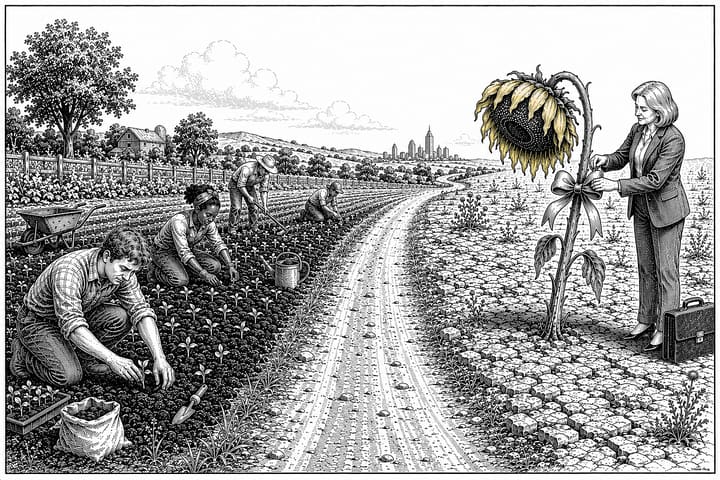
In fact, this is an example of the very apathy my grandfather warned against, wearing the costume of virtue.
I do not mean the person who has genuinely reckoned with their footprint and arrived at a thoughtful caution. That person I take seriously. I mean the far more common case, the one I see most weeks: the objection raised reflexively, by someone who could not tell you their household energy use, how their website is powered, or what their streaming habit costs, who has nonetheless decided that the AI prompt is where the line gets drawn. That is not consideration. It is its opposite. It is the refusal to do the hard arithmetic, ennobled by a green ribbon.
The framework I keep returning to is the one my grandfather would have recognized: net benefit, honestly assessed. Not whether a technology has a cost, because everything that touches the physical world has a cost. The real question is whether the good it does exceeds the harm it carries, and whether we are working in good faith to shrink that harm over time. A nonprofit that uses AI to reach more people, serve more need, and steward its resources more faithfully is almost certainly creating more good than the energy behind its tools destroys. Choosing to forgo all of that, to avoid an energy cost you have not actually measured, is also a choice. It also has a moral weight. We simply do not put it on the scale, because inaction never sends us an invoice.
The bigger risk has never been caring too much about the cost of acting. The bigger risk is not caring enough to ask the question at all.
You Have More Agency Than You Have Been Told
If there is one thing I want a reader to take from this, it is that the choice is not binary. It is not use AI and ignore the cost, or refuse AI and feel clean. The space between those poles is enormous, and it is where everyone honest actually lives.
Start with this liberating fact: your footprint does not have to be neutral. It can be net positive. You are allowed to emit and then to give back more than you took. I fly most weeks; I donate miles to environmental organizations and give to groups doing the work, not to erase the cost but to overcorrect for it. You can do the same, whether you are an individual or leading an organization. A person offsets through how they spend, what they eat, how they travel, and where they put their money. An organization does it through serious, verified programs. Not all offsets are equal, and the difference matters more than most buyers realize. The cheapest credits often pay for emissions avoided somewhere else, or for carbon stored in ways that may not last. The ones worth buying fund durable removal, carbon actually pulled from the air and locked away for the long term. It costs more, and it is the only version that does what the word offset promises. This is not penance. It is stewardship, and it scales.
To do this, you must use the leverage you actually have, which is larger than it feels. I have hosted around a hundred domains for years on a provider that runs entirely on wind, and that option exists only because enough people insisted it should. The internet runs cleaner today than it did when I started a dot-com in 1997, not because the companies grew virtuous on their own, but because users, customers, and citizens made noise until the market answered. The same pressure is available now, and it works the same way. Choose the cleaner option when it exists, and say loudly that you want it when it does not yet. Nashville proved that a community willing to show up can stop a thing in its tracks. That power did not come from feeling guilty about prompts. It came from people who decided to ask the question out loud, together.
There is a version of this argument that stops at permission: AI is probably fine, so go ahead and use it. That is not far enough. If apathy is the danger, then timidity is its quiet cousin. The person who uses AI only for trivial things, who rations it out of a vague guilt, is leaving on the table the one thing that might justify the energy in the first place. The carbon cost of a model is real. The waste is not in using it. The waste is in using it for so little.
A tool capable of accelerating cancer research, mapping food insecurity, modeling a watershed, or helping a five-person nonprofit do the work of fifty, and we reach for it to reword an email and then feel bad about that. The same technology straining the grid is also among the most promising instruments we have for healing it. AI is already accelerating the search for cleaner energy, better materials, and the geothermal and fusion breakthroughs that may one day make this entire debate sound quaint. To sit it out in the name of the environment is, in too many cases, to withhold one of the better tools we have for actually helping the environment.
This is where the net-benefit framework has been pointing the whole time. For the people and organizations whose work is to serve humanity, using AI well is not a guilty indulgence to be offset. It is closer to an obligation. Not using it carelessly, and not using it timidly, but using it deliberately, at full strength, aimed at the problems that matter most. That is how you earn the energy. Not by abstaining from it, but by making it count.
Crisis by Consent
My grandfather did not write a pessimistic book. People assume, from the title, that it must have been a warning wrapped in despair. It was the opposite. He believed deeply in people. That belief was exactly why apathy frightened him so much, because he knew what we were capable of when we finally chose to pay attention, and he could not bear to watch us sleepwalk past the moment when it mattered.
I think about the choices ahead of us the way he taught me to. The energy behind AI is real, and growing, and in some places it is landing hardest on people who were never asked. That is the short-term truth, and I will not soften it. But the same forces driving the demand are now driving the most serious search for clean and abundant energy in human history, and the arc, while far from guaranteed, is bending. That is the longer truth, and I will not abandon it to fashionable gloom. Both are true. The work is to hold them together without letting go of either.
He titled it Crisis by Consent because he understood that the gravest dangers do not usually require our agreement to proceed. They only require our silence. They advance through the averted gaze, the deferred question, the article a person keeps meaning to write and never quite does.
I am done consenting to my own silence on this one. Ask the question. Use the tools. Refuse the easy comfort of either certainty. And hold both.
Nathan Chappell, MBA, MNA, CFRE, AIGP is Chief AI Officer at Virtuous Software and co-author of Nonprofit AI, The Generosity Crisis and the forthcoming book, N1 Philanthropy. He writes about responsible innovation, the future of generosity, and the power of radical connection in the age of AI.
The environmental impact of AI is a complex and extremely nuanced subject which led to the greatest hesitation of whether I would write this article at all. I encourage you to go deeper in the exploration using the following links, many of which were referenced in writing this article. Figures reflect the best available estimates as of mid-2026. This is a fast-moving area, and the numbers will continue to change.
Energy demand and the scale of the build-out
- International Energy Agency, Energy and AI (April 2025) — the landmark analysis: ~415 TWh of data center electricity in 2024, projected to roughly double to ~945 TWh by 2030, near Japan’s total consumption. https://www.iea.org/reports/energy-and-ai
- International Energy Agency, Key Questions on Energy and AI (April 2026) — the follow-up update: data center electricity grew 17% in 2025 against 3% global growth, AI-focused demand surged 50%, and the five largest tech companies’ capital spending topped $400 billion in 2025, set to rise another 75% in 2026. https://www.iea.org/reports/key-questions-on-energy-and-ai/executive-summary
- IEA news release announcing the 2026 update. https://www.iea.org/news/data-centre-electricity-use-surged-in-2025-even-with-tightening-bottlenecks-driving-a-scramble-for-solutions
The energy cost of a single query
- Epoch AI — independent research on the energy use of a typical AI query (~0.3 watt-hours) and the growth rate of training compute.
https://epoch.ai/
- Hannah Ritchie, Sustainability by Numbers — a clear, well-sourced walk through the 2025 IEA numbers and the per-query footprint.
Efficiency, and why it has not reduced total use
- The Jevons Paradox — background on why efficiency gains have historically increased, not decreased, total consumption. https://en.wikipedia.org/wiki/Jevons_paradox
Communities and the local cost of data centers
- Bloomberg, Meta’s Giant AI Data Center Is Reshaping Rural Louisiana — the Hyperion campus in Richland Parish, community impact, and the gas-plant build-out. https://www.bloomberg.com/features/2026-meta-facebook-ai-data-center-louisiana/
- Sierra Club, In Rural Louisiana, Meta’s New Data Center Promises Growth — But at What Cost? — community impacts, and the brown tap water reported near Meta’s Georgia data center. https://www.sierraclub.org/sierra/rural-louisiana-meta-s-new-data-center-promises-growth-what-cost
- Nashville Banner — coverage of the June 2026 Metropolitan Planning Commission meeting and opposition to the proposed data centers near the Nashville Zoo and Fisk University. https://nashvillebanner.com/2026/06/12/nashville-data-centers-planning-commission-meeting/
- WSMV — the petition against the zoo-adjacent project surpassing 400,000 signatures. https://www.wsmv.com/2026/06/14/petition-against-proposed-data-center-next-nashville-zoo-gets-more-than-400000-signatures/
- WKRN — the mayor’s executive order and the Metro Council’s moratorium. https://www.wkrn.com/news/local-news/nashville/nashville-data-center-moratorium/
Where cleaner energy may come from
- Fervo Energy — Cape Station enhanced geothermal project in Utah.
https://fervoenergy.com/
- Rhodium Group — analysis of geothermal’s potential to meet data center demand growth.
https://rhg.com/
- Helion Energy — the commercial fusion power agreement with Microsoft.
https://www.helionenergy.com/
- Google, Project Suncatcher — orbital (space-based) compute initiative. Google Project Suncatcher overview
Originally published on Nathan’s Substack.