Community Is a Growth Industry
Why the next decade will reward the thing AI cannot make.

May 26, 202614 min read
After a keynote in a hotel ballroom whose name I no longer remember, a man approached me as the room cleared. He had waited until the room was nearly empty, and when he reached me he did not ask the question I usually get, which is about a tool, or a vendor, or whether one model is better than another.
He asked, “How do you personally manage it?”
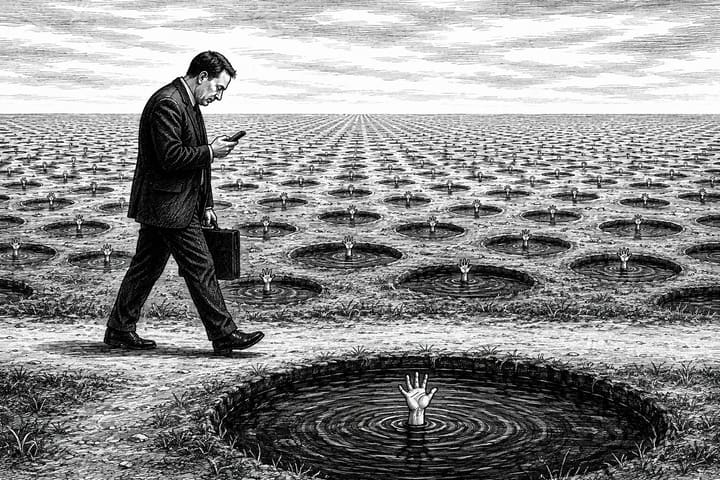
I knew what he meant. The unrelenting pace. The reading list that grows three articles for every one finished. The expectation that I will have already used the newest model released this morning. The anxiety that arrives not because the work is hard but because the floor keeps moving.
I have been working in AI for almost a decade. I have written two books on the intersection of AI and generosity, and helped build a global community of people trying to use AI responsibly. People often ask me, with the benefit of all those years, what I did not see coming.
It is not the capability. It is not the scale. It is the speed.
For most of the last decade, I could keep up. I could read the paper, try the tool, write the post, and feel I was still in front of the wave. Then somewhere around 2024 the wave broke over my head, and ever since I have been trying to figure out what it means to live and lead inside a current this fast. The man at the end of the line had felt the same current. He wanted to know how I was managing it.
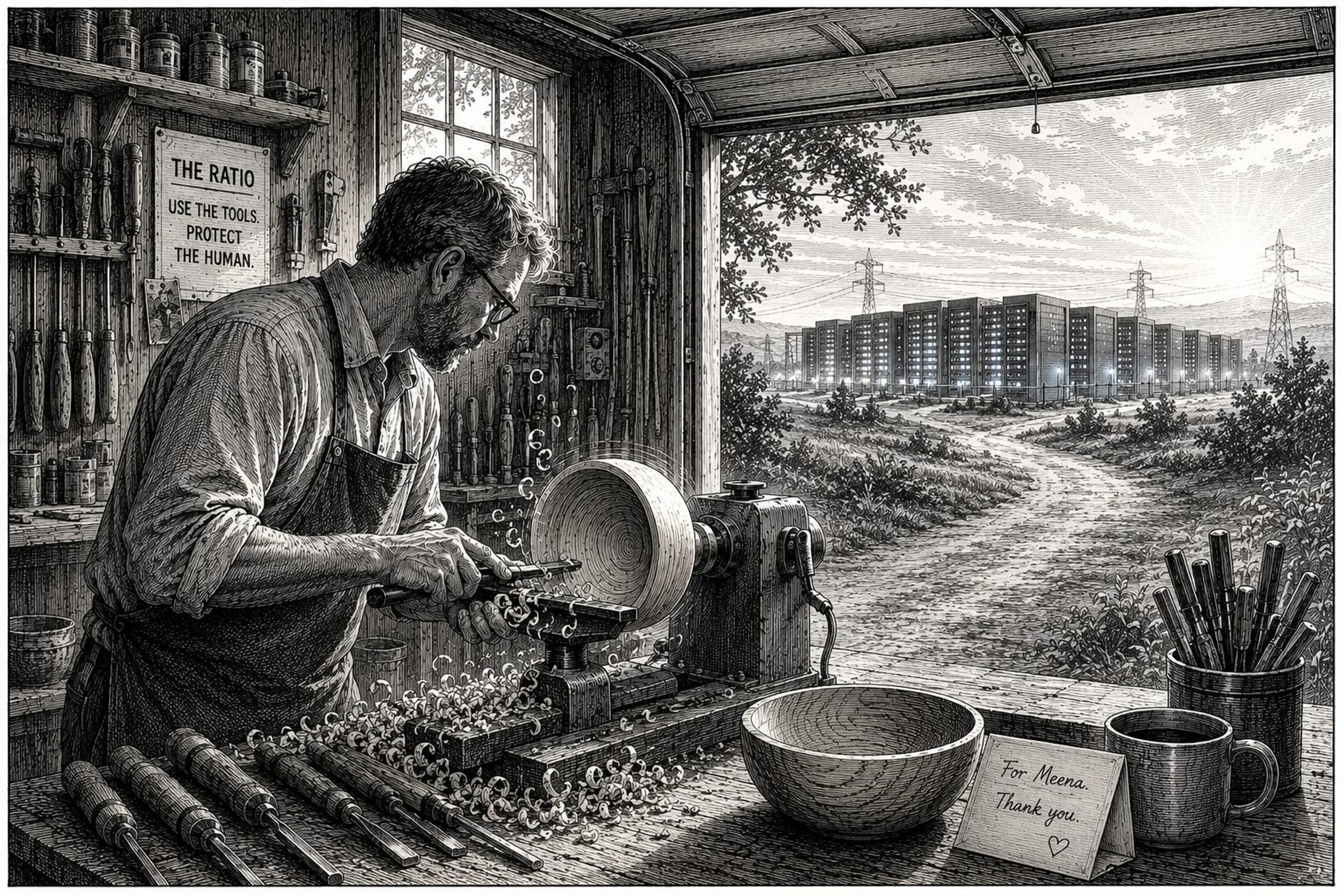
I told him I have started keeping a ratio. For every hour I spend inside an AI tool, I try to spend an hour outside of one. Not in opposition. In counterweight.
I take walks. I tend a garden. And, in the corner of my garage, I turn wood.
Wood turning is a craft most people have never watched. You take a piece of raw timber, mount it on a lathe, and shape it with a chisel while it spins at thousands of revolutions a minute. You can ruin the piece in a second. You can also, slowly, find a bowl inside what used to be a fallen oak. I do not turn bowls so that someone will eat more salad. I turn them because I am holding something in my hands that I am making for a specific person, and the entire time I am shaping it I am thinking about them.
This is not productivity. This is the opposite of productivity. It is presence with material, and presence with a person I’m grateful for, on either end of a piece of wood.
When I told the man this, he nodded slowly. “I need more of that,” he said. And I realized that was the real question he came to ask. Not how I manage the pace. How any of us are going to find our way back to the thing the pace has been crowding out.
To be clear, my answer to him was not to use less AI. I use more AI than almost anyone I know, and I will use more next year than this year. AI is the most consequential technology of our lifetimes, and the nonprofit sector cannot afford to sit it out. The ratio I described to him is not about retreat. It is about counterweight. The more AI I use, the more I have to protect the part of life AI cannot touch, because that is where the meaning is kept.
I have good news for him, and I have good news for our sector. The way back is not just available. It is already trending. And the path forward runs through more AI, not less.
Community is a growth industry.
I have been saying this phrase out loud for several months, ever since I wrote a piece called Sorry I Made You Cry and casually told a colleague that the work she was doing in human connection would only become more valuable, not less. The phrase has caught on more than anything else I have said recently. People write it down. One person told me she wanted to put it on a t-shirt. Another asked if she could quote it in her board meeting. I think they reach for it because it gives them permission to believe what they already suspect: that the relationships they build and steward are not about to be displaced by the next model release. They are about to be revalued.
The evidence is starting to show up in places where you would not expect it. Earlier this year, for the first time, LinkedIn’s annual Jobs on the Rise report placed fundraiser among the fastest-growing roles in the United States. Fundraising. The job most of the sector has spent twenty years apologizing for. The job that pundits had quietly written off as automatable by better data tools. Not only did it climb the list. LinkedIn published a follow-up explaining what fundraisers do, how they get hired, and why their work is suddenly being recognized as essential.
You can read that as a quirk of the data. Or you can read it as the first ripple of a much larger wave.
Look around. The wave is already cresting in places most of us do not normally look for sector news.
Vinyl records, declared dead twice in my lifetime, have outsold CDs for several consecutive years and are projected to keep climbing. Cassette tapes, of all things, are back. Independent bookstores are opening, not closing, for the first time in a generation. Film cameras are commanding waitlists. Sourdough did not stop with the pandemic; it became a permanent reorientation toward making something with your hands. Run clubs have exploded across major cities, with twenty-somethings forming the kind of in-person gatherings that nobody predicted would belong to the most-online generation in history. Letter writing is making a quiet return. Phone-free dinners are showing up on restaurant menus as a feature, not a quirk. Dumb phones, designed to do almost nothing, are being purchased on purpose by people who already own iPhones.
None of these is a single data point. Together, they are a tide.
People are not abandoning technology. They are reclaiming the parts of life that technology never should have replaced.
This is not nostalgia. Nostalgia is sentimental. What is happening is structural. A culture that spent thirty years moving everything onto screens is now, deliberately and at scale, moving some of it back off. The instinct is the same one driving the man in the hotel ballroom. People want to hold something. Hear something. Sit across from someone. Do a thing that does not refresh.
And the sector that has been organizing this kind of presence for two hundred years, often while being told by its own boards to be more efficient, is suddenly sitting on the asset everyone else is trying to find.
It is not just consumers making this turn. The market is forcing it too.
In early 2024, the Swedish fintech Klarna announced, with considerable fanfare, that its OpenAI-powered chatbot was doing the work of seven hundred customer service agents. The company froze hiring. Its CEO, Sebastian Siemiatkowski, became a kind of patron saint of the AI-first staffing strategy, telling anyone who would listen that this was the future of work.
A year later, he walked it back.
Klarna is now rehiring human customer service agents, and Siemiatkowski has been disarmingly candid about why. “Obviously, AI today can pretend to be empathetic and express emotions and stuff,” he told Semafor, “but at the core, people crave human connection.” He has gone further, predicting that a real human at the end of the line will become “a VIP thing” for which customers pay a premium.
Read that twice. The CEO of a buy-now-pay-later company, in the most cost-conscious vertical in finance, is now publicly arguing that human presence is the upmarket offering. That is not a moral position. That is a market position. And it is the most honest admission yet that there is a thing AI cannot do, and the thing it cannot do is what the nonprofit sector has been doing all along.
Being heard. Being seen. Belonging. These are not soft outputs. They are the products our sector ships every day. We just have not been taught to price them that way.
Two voices from outside the nonprofit conversation have, in recent months, said the same thing in different vocabularies.
Andrej Karpathy, one of the most thoughtful builders in AI, has argued that anything verifiable will eventually be done by AI. That is a sentence worth internalizing. If a task can be evaluated against a clear answer, eventually a system will perform it faster, cheaper, and more consistently than a human. Spreadsheet reconciliation. Document summarization. Code that compiles. Forms that route. Prospects that get scored.
This is not a warning. It is a gift. Every verifiable task that AI absorbs is a human hour returned to the work only humans can do. The sector that figures out how to redirect that returned hour into deeper relationships, more thoughtful gratitude, and more individualized attention is the sector that wins the next decade.
What is not verifiable becomes more valuable, not less.
Judgment. Taste. Trust. The look on a donor’s face when she finally tells you why this cause matters deeply to her. The phone call that begins with a death and ends with a gift. The presence in the room.
Scott Galloway, the NYU Stern marketing professor, bestselling author of The Algebra of Wealth and Adrift, and host of the Prof G podcast, said it almost the same way recently when asked what young people should do to differentiate themselves in a labor market being reshaped by AI. His answer was that the point of differentiation is relationships. He was not being sentimental. He was being mercenary. He was telling young professionals what the next economy would pay for.
Two men, from opposite ends of the conversation, arrived at the same observation. The verifiable will be commoditized. The relational will compound.
For a sector whose entire business model is the relational, this is the best news of the decade.
If you want to know where the culture is heading, watch the people who grew up most fluent in it.
Gen Z is the first generation to come of age entirely inside the algorithm. They have never known a world without smartphones, social feeds, or recommendation engines shaping what they see, hear, and want. By every reasonable expectation, they should be the population most comfortable handing more of life over to machines.
They are doing the opposite.
In the past few weeks, several graduation ceremonies have gone viral for the same reason: graduates booing speakers who espoused the virtues of AI in their commencement remarks. There is a growing movement inside Gen Z that romanticizes the analog 1990s, deletes apps for the third time this year, and treats a flip phone as a moral statement. Ironically, there are entire TikTok subcultures dedicated to wired headphones, point-and-shoot cameras, and refusing the algorithm in small daily ways. They are starting book clubs and supper clubs and walking clubs. They are advocating for phone-free high schools and winning. They are, by some measures, drinking less, dating less online and more in person, and asking harder questions about meaning, faith, and purpose than the generation before them.
I have heard older observers dismiss this as a phase. I think they are misreading it.
This is not Gen Z rejecting technology. This is Gen Z, the most technologically fluent generation in history, telling the rest of us what technology should not do.
They are the leading indicator. When the cohort that knows the algorithm best is the cohort most loudly signaling what is human, that is not noise. That is information about where the rest of the culture is heading next.
The graduates are not booing AI in the abstract. They are booing the same leaders who tell them, in one breath, that AI will save the world and, in the next, that it will replace half their jobs before they are thirty. They are booing the hype itself: the cheerful inevitability, the breathless promises, the refusal to take seriously what this technology is already doing to the entry-level work, the climate, and the concentration of power. They are more attuned to second-order consequences than the people speaking at them. That is a sharper critique than it first appears. It is the critique of the entire counterfeit economy that AI threatens to produce if we do not insist on something better. And it is being delivered by the very people the rest of us were told would not notice.
They are noticing. They are choosing. And they are about to spend the next forty years building the institutions that reflect their choices.
If you are wondering whether the relational sector has a future, watch the eighteen-year-olds. The future is already in the room.
Here is where the nonprofit sector has a structural gift that almost no one else has, and that almost no one in our own sector talks about enough.
A 501(c)(3) is not a company. It is, by its legal definition, a public benefit corporation: an entity that exists by and for the community it serves. Its trust currency is not a quarterly result. Its differentiation is not a feature set. Its product, when you strip everything else away, is human relationship organized around a shared sense of what matters.
Every nonprofit in America is already in the business the rest of the economy is about to discover it needs to be in.
That is not a soft observation. That is the entire thesis. While the rest of the labor market is being asked, sometimes brutally, to figure out what humans are still for, the nonprofit sector has been answering that question for two hundred years. We did not need AI to teach us that relationships are the asset. We have been quietly compounding that asset for generations.
The good news, the actual good news, is that the wider culture is finally catching up with what our sector has always known. The mega-trends are pointing our direction. The labor market data is pointing our direction. The most digitally fluent generation in history is pointing our direction. The world is, slowly and then suddenly, walking toward us.
Our job is not to chase relevance. Our job is to make room for the people arriving.
Here is the part of the case that gets missed. The future I am describing does not require less AI. It requires more of it, used better, by people who understand what it is actually for.
The opportunity in front of us is to let these tools absorb the verifiable so humans can be freed for the unverifiable. To use them to remove the friction that has been keeping fundraisers in spreadsheets when they should be on couches. To use them to extend the reach of every staff member into a thousand individualized relationships that, without these tools, would have collapsed into a mail merge. AI is the leverage that finally allows the relational sector to scale the thing it has always done best: making one person feel known.
This is the work of the next decade for our sector. Build the AI muscle. Use the tools. Automate the verifiable. Reinvest the recovered hours into the relationships that have always been our currency. The nonprofits that refuse to engage with AI will not preserve their humanity. They will only forfeit their leverage to those who feel no obligation to it.
And it means remembering the other half of the ratio. The walk. The garden. The vinyl on the turntable. The bowl turned for a specific person. The phone call that was not on the calendar. The hour without a screen. These are not luxuries we have earned by being productive. They are the source material of the relationships our missions are built on.
If we lose our own capacity for presence, we cannot offer it to anyone else. If we protect it, while building the AI muscle that scales our reach, we become the place the world is looking for.
There is a piece of unfinished oak on the lathe in my garage right now. It is going to be a bowl for someone I’m grateful for, and every time I pick up the chisel I am thinking about her. The bowl will not be perfect. It will be slow. It will not scale.
It will also be one of the most valuable things I make this year.
Tomorrow morning I will be back at my desk, using AI to do more in an hour than I could have done in a week ten years ago. Both of those things are true, and both of those things are necessary. The future belongs to people and organizations that can hold both hands of the ratio at once. Build the AI muscle. Protect the human one. Refuse to choose between them.
That is the part the future is about to figure out. Not everyone all at once, and not in a straight line, but inexorably, the way these things go. The verifiable will be cheap. The relational will be prized. The atomized will get tired of being atomized. The eighteen-year-olds will keep choosing what is human, and the rest of the culture will follow them, the way it always has. The questions about who we are and what we are here for will keep pushing people out of their feeds and back toward each other.
And the sector that has, all along, been organized around exactly that movement is about to have its moment.
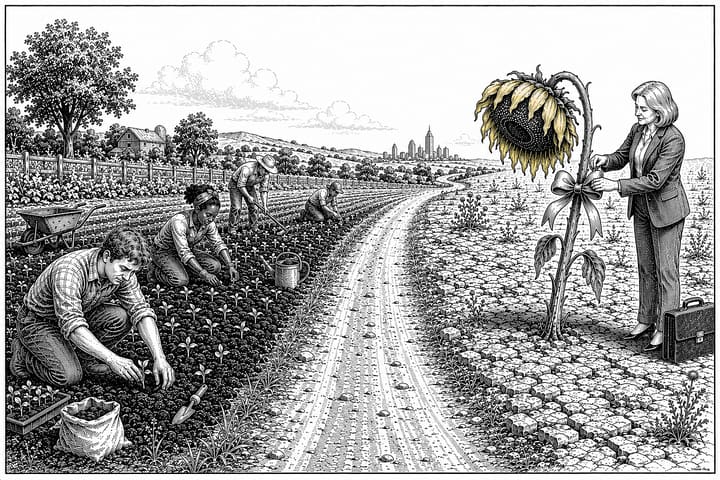
Community is a growth industry. Plant accordingly.
About the Author
Nathan Chappell, MBA, MNA, CFRE, AIGP is Chief AI Officer at Virtuous Software and co-author of Nonprofit AI and The Generosity Crisis. He writes about responsible innovation, the future of generosity, and the power of radical connection in the age of AI.
Originally published on Nathan’s Substack.