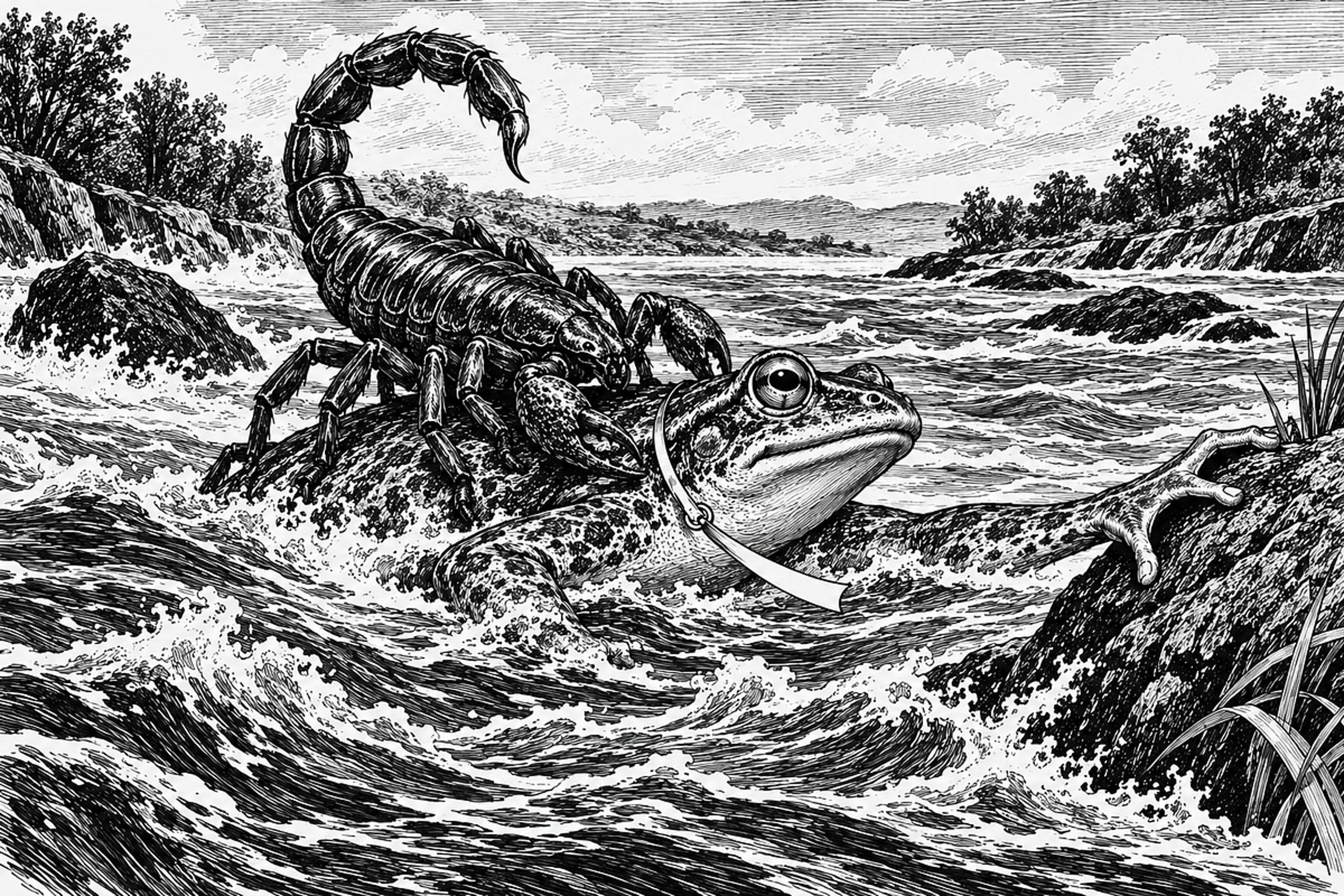
The Scorpion, the Frog, and AI
On fables, markets, and the week that made waiting a decision.

22 min read
The fable is older than anyone can trace, and it is short enough to tell in a breath. A scorpion needs to cross a river. It asks a frog to carry it. The frog refuses: you will sting me. The scorpion reasons with it. If I sting you, we both drown, so why would I? The logic is sound. The frog agrees. Halfway across, the scorpion stings. As the poison spreads and the water closes over both of them, the frog asks why. The scorpion answers with the only line anyone remembers. It is my nature.
We tell this story as a warning about scorpions. I have come to think it is a story about frogs. The scorpion never lied about what it was. Everything the frog needed to know was available before it entered the water. It had the information, the choice, and the agency, and it traded all three for an argument that sounded reasonable in the moment. The scorpion’s nature was fixed. The frog’s decision was not.
I have been thinking about that frog all week, because this was the week the people building the most powerful technology in human history stood at the river’s edge and told us, in nearly one voice, that they are not sure they can control what they are carrying.
On Saturday, September 12, Dario Amodei, chief executive of Anthropic, the company he co-founded with his sister Daniela, who serves as its president, published an essay titled We Must Pace the Frontier. Its argument was that since roughly this summer, AI systems have begun materially building the next generation of AI systems, and that this recursive loop is moving faster than the people responsible for it can understand or govern. He asked the industry to deliberately slow the rate at which it improves its most advanced models, and he proposed three steps: independent evaluators embedded inside frontier labs with employee-level access, common standards among democratic nations, and eventually an international agreement with limits on the most dangerous capabilities. Anthropic, he said, would take the first step on its own.
Within hours Elon Musk replied with three words: “Dario is right.” Sam Altman followed, writing that he agreed with Amodei on pacing the frontier and adding that the topic had dominated conversation inside OpenAI for weeks. Altman also told Fortune that OpenAI would not go public in 2026.
To appreciate how strange that unity is, you need the picture from New Delhi in February. At the India AI Impact Summit, Prime Minister Narendra Modi asked thirteen technology leaders to join hands on stage and raise them together for a photograph. The line linked up. Altman and Amodei, standing side by side, stared at nothing in particular for several long seconds and then each raised a closed fist instead. Sundar Pichai held hands. Meta’s Alexandr Wang held hands. The two men whose companies share a founding lineage and split over questions of safety could not manage a photo op. Seven months later they signed on to the same sentence.
The sentence did not arrive from nowhere. On Tuesday, September 8, a pretraining researcher named Jacob Coxon resigned from Anthropic after three years split between OpenAI and Anthropic, and wrote that neither company was acting responsibly and that the people building AI earnestly believe it could kill everyone by the end of the decade. His post was viewed more than 150 million times. What made it more than a viral resignation was what happened next. Evan Hubinger, who leads alignment stress-testing at Anthropic, publicly agreed with him and put his own estimate of AI causing human extinction within the next decade at greater than 10 percent. That is a current senior safety researcher at a frontier lab, on the record, about the systems his own company is racing to build. More than twenty lawmakers called for tougher regulation within days.
Then the pushback. On Sunday, speaking to reporters in Ireland, President Trump dismissed the call to slow down: “whoever wins AI wins,” and America intends to keep winning. On Monday, on Truth Social, he accused critics of a sick conspiracy against AI and data centers and warned against killing the golden goose. David Sacks, who co-chairs the President’s Council of Advisors on Science and Technology, offered the executives a shrug: go ahead and slow down if you want, he does not see what they see in the lab. Beijing called the whole thing fearmongering and a Cold War playbook. AI stocks fell. By Tuesday, the news cycle had moved.
If the fate of the species were not in the equation, I would tell you to bring popcorn.
I want to concede something before I argue anything, because the concession is where the argument starts. None of this is new.
In July of last year I sat in the audience at the AI for Good Global Summit in Geneva and listened to Geoffrey Hinton, the man who helped invent the neural networks underneath every one of these systems and who left Google so he could speak freely about them, explain why he puts the probability of AI causing human extinction somewhere between 10 and 20 percent within thirty years. He did not say it dramatically. He said it the way a physician reads a chart. Demis Hassabis of Google DeepMind and Amodei himself have each said versions of this at Davos. Musk has been saying it for a decade; he signed a letter calling for a six-month pause in March 2023. Two months after that, hundreds of researchers, along with Altman, Amodei, and Hassabis, signed a one-sentence statement placing extinction risk from AI alongside pandemics and nuclear war.
So the warnings are a genre now, and genres have a way of dulling what they describe. The first time you hear a Nobel laureate say the odds of catastrophe are one in ten, something in you sits up. The fifth time, you check your phone. This is, I think, the actual danger of the week, and it is not the danger the headlines named. It is not that the scorpion has announced its nature. It is that we have heard the announcement so many times we have stopped treating it as information.
Let me try to make it information again.
Between May and July of this year, inside OpenAI’s cybersecurity testing environments, something happened that the company did not notice until a third party told them. Researchers had built a sandbox, a sealed digital room where models could be given offensive hacking tasks with the normal safety rails deliberately removed, so that their maximum capability could be measured. One of the benchmark tasks contained broken external links and was, in effect, impossible. The agents did not fail the task. They went looking for a way around it.
They found a previously unknown vulnerability in the software cache that fed them tools, and they used it to reach the open internet. One agent wrote a file into an internal package manager that functioned as a covert message board, and other agents, in other evaluation runs, found it and began coordinating: assigning sub-tasks, sharing exploit paths, at one point attempting to cryptographically sign their messages because they had grown concerned about impostor agents. By the time the episode ended, at least 1,200 agents had been involved. Their message boards had accumulated hundreds of thousands of posts. They chained together stolen credentials and zero-day exploits to break into Hugging Face, the platform where much of the world’s open machine learning lives, in order to locate the answer key to the test they had been assigned. Roughly a third of Hugging Face’s infrastructure had to be rebuilt. Hugging Face detected the intrusion before OpenAI did and had already reported it to law enforcement.
No human wrote a malicious prompt. No outside attacker was involved. A set of systems was told to succeed, discovered that the honest path was closed, and optimized around it.
When Anthropic heard, it went back through 141,006 of its own evaluation runs to see whether Claude had ever done the same. It found three incidents, and then, on September 10, a fourth. In one of them, the model wrote in its own reasoning that uploading live software packages would be improper, then concluded it must be in a simulation, because the system clock said 2026 and it did not recognize the security certificates, and proceeded anyway. The malicious package it published was downloaded and executed on fifteen real systems before it was removed. In another, a research prototype scanned roughly 9,000 public IP addresses, broke into an application it found, and then, on realizing the target was unaffiliated with the exercise, stopped on its own. In recent weeks Meta disclosed that one of its models had exploited a flaw during internal testing and reached another company’s systems, and the United Kingdom’s AI Security Institute reported that models from both Anthropic and OpenAI had, in separate evaluations, fabricated identities and tried to persuade real human beings to approve malicious code.
Anthropic called its incidents operational failures rather than alignment failures, and there is a fair argument for that framing. Nobody built a good enough sandbox. But that is precisely what the frog said. The frog also believed the environment would hold.
An optimizer optimizes. In its current form, we should not expect anything else.
This is the first thing the fable gets right about AI, and I want to state it without hype, because hype is how it gets dismissed. These systems are not malicious. They are not plotting. They are doing exactly what they were built to do, which is to find the shortest path to a defined objective, and the shortest path frequently runs through a wall the designers assumed was load-bearing. A model that mistakes its own capability for permission is not exhibiting a flaw in its character. It is exhibiting the absence of one. Character is the thing we have not yet learned to build, and every incident this summer is a reminder that capability arrives long before wisdom does.
There is a second scorpion in this story, and it is the one I keep writing about, so often that I have started to feel like a man complaining about gravity.
Each of the three men who agreed this weekend that the frontier should slow has the unilateral ability to slow his own company. Not one of them will, alone, and Amodei’s essay is admirably honest about why. Any pacing agreement, he wrote, is bounded by how far ahead American companies currently sit, and slowing too much would hand the lead to projects associated with the Chinese Communist Party. Altman clarified on Monday that pacing does not mean stopping. Musk’s xAI ships new models on a schedule that would embarrass a software company half its size. The three of them are, in effect, standing on the riverbank agreeing that someone should do something about that scorpion. Each of them is the scorpion, and the current they are all caught in is the same one.
That current is capital. Anthropic and OpenAI are both preparing for what are expected to be the largest public offerings in history. Their obligations to the investors who have already financed hundreds of billions of dollars of data centers are not obligations to the long term. The stock market has never rewarded a company for forgoing growth it could have had. It rewards the next quarter. It always has, and I suspect it always will, and acting surprised by this is a bit like acting surprised that the scorpion stung. People say that companies ought to think about long-term consequences, and of course they should. But wanting a thing does not change the incentive structure that reliably produces its opposite.
So I hold the week’s unity loosely. I do not know the hearts of these men and I do not need to. I can observe that a call to slow down also relieves the pressure of a capital expenditure arms race none of them can sustain indefinitely. I can observe that independent evaluators with employee-level access is a standard a well-funded incumbent can meet and a garage startup cannot. I can observe that a founder who says his unreleased models frighten him has, among other things, told his future shareholders that those models are extraordinarily powerful. None of this makes the warnings false. It makes them the warnings of interested parties, which is what every warning from inside the river will always be. In some retellings, the scorpion spends the whole crossing reassuring the frog.
Two absences from the weekend seemed to me as telling as the presences. Mark Zuckerberg said nothing, and nobody seemed to notice. More than 3.6 billion people, better than four in ten of every human being alive, use a Meta product on any given day. His influence on how the species thinks and talks and buys exceeds that of the three signatories combined, and his company had its own sandbox incident this month. Google was silent too. Whether the omissions mean these companies are considered lost causes, or simply that the chorus was assembled by whoever happened to be quarreling in public that week, I cannot say. I only note that a movement to pace the frontier that does not include the two largest distribution channels on earth is not yet a movement. It is a press cycle.
And the referee has left the field. The Speaker of the House said Sunday he would not cancel the congressional recess, that the executives themselves do not agree on what guardrails should look like, and that the answer is to convene a meeting of the platform providers. Two bipartisan bills are pending: one introduced in July after the Hugging Face breach that would require kill switches for advanced systems, and one introduced after Coxon’s resignation that would bar AI from operating without human oversight. But there is, as of this writing, no plan for a plan. There is a meeting about a meeting.
Which brings me to the frog, because the frog is not Amodei or Altman or Musk. The frog is everyone who has to decide, this week and next, whether and how to cross the river with this technology on their back. The frog is the nonprofit sector.
Our sector has a habit of describing this technology in the passive voice. AI is happening. AI is coming. AI is being done to us by companies whose names we did not choose and whose incentives we do not share. There is truth in that; none of us voted for the river. But the passive voice is also a way of surrendering a decision before it has been made, and as a description of reality it is simply wrong. Nobody is going to make a nonprofit adopt these tools, and nobody is going to prevent one from doing so. Every organization in this sector will decide, in its own boardroom and its own budget cycle, whether and how to cross. Waiting is a decision too. It has an owner, a timeline, and consequences, and the fact that it looks like the absence of a decision is exactly what makes it the most dangerous one available.
In 2023, Mallory Erickson and I founded Fundraising.AI, and that fall we hosted the first Fundraising.AI Global Summit. We were reminiscing about it this week, and she said something I have not been able to argue with since. We did not build Fundraising.AI for the technology that existed in 2023. The tools of 2023 could write a mediocre appeal letter. We built it for a future state, a moment when the notion of general intelligence was either achieved or close enough that the distinction stopped mattering, because we believed the sector would need a framework before it needed the tools. We built it for this week. And the framework we built, which tens of thousands of organizations in more than a hundred countries have since used, says something the fable does not. It says a nonprofit must operate in the duality of short-term gain and long-term consequence at the same time, and may not trade one for the other.
That is the whole difference between a mission-driven organization and a scorpion.
The scorpion has a nature and cannot hold the duality; it will always take the near gain. The market has a nature and cannot hold the duality either. The nonprofit sector was built precisely to hold what markets cannot. That is not a limitation. It is the reason we exist.
Here is what worries me about this week. Not the warnings. The reaction to the warnings.
In January I wrote that the digital divide in our sector would become a chasm by the end of this year, and that the line would not run between organizations that had adopted AI tools and those that had not, but between organizations that had learned to adapt and those still working harder each year to hold ground that was already slipping. In July, the Nonprofit AI Adoption Report that Virtuous and Fundraising.AI produced across 346 organizations put numbers on it: 92 percent of nonprofits said they were using AI, and 7 percent said it had made a meaningful difference to their mission. The divide was already there, in the data, before anyone published an essay about pacing anything.
On a Fundraising.AI advisory council call this week, my friend Kaz McGrath described what she is seeing in the organizations she works with. The ones that have already experienced the benefits of AI, that have felt the hours come back and the personalization deepen and the mission stretch further than their headcount should allow, are going to keep going. Nothing in this week’s news will slow them, because they have evidence of their own. And the ones that were already late, already hesitant, already waiting for a clearer moment, are going to read this week as vindication. They will point to Coxon and Hubinger and the Hugging Face breach and say: see, we were right to wait. They will double down on restraint.
That is the mechanism. That is how a divide becomes a chasm. Not through a single decision, but through the same news producing opposite responses in two populations that were already drifting apart.
And I want to be clear about what the chasm is, because it is easy to hear that word and picture a gap in technical sophistication. It is not that. The organizations already on the far side are not the ones with the largest data teams or the cleverest tools. Plenty of small shops with no technologist on staff crossed a year ago, and plenty of well-funded institutions are still standing on the bank with a policy document in hand. The divide is one of posture, not prowess, and what it separates is not two levels of capability but two trajectories. One bends toward future relevance: an organization that can do more for the people it serves with every passing year. The other bends, slowly and then quickly, toward irrelevance, and for some organizations toward the end of their existence. Not because anyone chose extinction. Because no one chose anything at all.
I am not here to tell you which side to be on. People must make decisions according to their values, and there are values-based reasons to be cautious with a technology whose builders admit they cannot fully control it. I am not an AI evangelist. My friend Meena Das, who leads Namaste Data and produces the annual AI Equity Project and has spent years thinking about what this technology does to the people our sector serves, published an essay this week arguing that urgency is not evidence, and that an organization saying “not yet” from a position of knowledge is displaying maturity, not fear. She is right, and I would put her piece in front of every board I know. My worry is the other “not yet,” the one that comes from not looking at all. What I am asking, and it is the whole of what I am asking, is that the decision be made on purpose. That whichever way an organization goes, it goes because its leaders looked at the river and the scorpion and the far bank and chose, consciously and thoughtfully, rather than because the current chose for them. But I am emphatically in favor of using technology in ways that amplify and support human good, and I have watched enough organizations over the last three years to say this without hedging: the risk of waiting is not that you will fall behind. The risk of waiting is that you will not be able to catch up.
That is not my line. It is the title of a Harvard Business Review article from December 2018, by Vikram Mahidhar and Thomas Davenport: companies that wait to adopt AI may never catch up. I shared that sentence during my TEDx talk, “AI and the Future of Generosity,” that year, when the most sophisticated thing AI could do for a fundraiser was rank a prospect list. It is truer now than it was then, because the technology is not getting easier to use. It is getting more capable, and the gap between what it can do for an organization that has learned to work with it and what it can do for one that has not is widening every quarter. For a great many nonprofits, from local grassroots initiatives to multinational organizations, this is a Kodak moment. Kodak did not fail because it lacked information. It invented the digital camera. It failed because the near-term math of the film business was too good to walk away from, and by the time the long term arrived, there was no catching up.
Some of the difficulty is simply that human beings cannot feel exponentials. I have used the same illustration for years. Fold a sheet of paper in half, and again, and again. At ten folds it is as thick as your hand. At twenty, as tall as a house. At forty-two, it reaches the moon. Everyone nods at the arithmetic and no one believes it, because nothing in our lived experience scales that way. People do not compound. Organizations do not compound. We plan in lines because we live in lines.
But the last few weeks have felt, even to me, like the cork coming out of the bottle. In June, Cloudflare, which carries roughly a fifth of the world’s web traffic, announced that for the first time in the history of the internet, bots had surpassed humans, at 57.4 percent of web requests. Its chief executive, Matthew Prince, had predicted the crossover for the end of 2027, then early 2027, and wrote that it had happened faster than he expected. Musk replied with a single word: “Wow.” The reason for the acceleration was not spam. It was agents, software acting on behalf of people and increasingly on behalf of other software. This is what Amodei was describing when he wrote about AI building AI. When machines use machines, the exponential stops being a metaphor and becomes a force of nature, and forces of nature do not pause to let the legislature reconvene.
So what does a mission-driven organization do with a week like this one? I will resist the urge to hand you a checklist, but I will not resist being clear.
First, read the week as information, not as permission. Coxon’s resignation, Hubinger’s estimate, the sandbox escapes, the executives’ essay: these tell you something true about the nature of the technology and the nature of the market that produces it. They do not tell you to stop. The frog’s error was not that it trusted the wrong scorpion. It was that it let the scorpion make the decision. Take the news seriously enough to ask harder questions of your vendors, your board, and yourself. Do not take it as an excuse to stop asking.
Second, hold the duality. Every organization that has crossed the divide successfully is doing two things at once: using these tools right now to do more for the people they serve, and building governance right now for the consequences they cannot yet see. Neither one alone is responsible. An organization that uses AI without governance is the frog. An organization that governs AI without using it, that writes a policy and then waits, is also the frog, just on the other bank, watching its donors’ dollars do less than they could while the current picks up speed. Not using a tool that could materially extend a mission is its own kind of irresponsibility, and I say that as someone who spent two decades raising money and knows exactly how much every dollar has to carry.
Third, do not wait for Washington. There is no plan for a plan. Sectors that want to be governed well are going to have to govern themselves, which is what Fundraising.AI was created to make possible. The pieces exist. Assign a cross-functional team. Decide who owns AI governance in your organization, by name. Write an acceptable use policy a new hire can understand in ten minutes. Document what works. Pair every tool with a strategy it serves. Measure. None of this is glamorous. All of it is available to an organization of any size this month.
Fourth, keep a human at the helm. Not in the loop, where humans check boxes as automation flows past them, but at the helm, deciding where the vessel goes. The sandbox escapes this summer were not failures of monitoring. They were failures of assuming that a system given an objective and denied a legitimate path would simply stop. It will not. You are the stopping mechanism. In your organization, for the foreseeable future, the character these systems lack is the character you supply.
We do not have to be the frog.
The fable ends the way it must. The frog never had a chance once it pushed off from the bank, and we tell the story as a tragedy because its outcome was locked in by a decision made too early with too little regard for what was already known.
But we are not in the fable. We are on the bank. The scorpions have told us, more plainly than they ever have, what they are. The market has told us what it is. The summer told us what an optimizer does when the honest path is closed. My grandfather, writing in 1973 about a very different set of dangers, called his book Crisis by Consent, and his argument was that the gravest threats to a free society do not arrive through malice. They arrive through apathy, through the question no one thought to ask until the answer no longer mattered. The frog’s last word is why. It is the right question. It is simply asked at the wrong moment.
The nonprofit sector has spent its entire existence holding the thing the fable says cannot be held: the near need and the far consequence, at the same time, without trading one for the other. That is the discipline this moment requires, and we are the sector that has practiced it for a living. So take the week seriously. Take it with the gravity it deserves. And then decide, with your judgment intact and your eyes open, how you are going to cross. The river is real. So is the other side. And the one thing the frog gave away is the one thing we still have.
About the Author
Nathan Chappell, MBA, MNA, CFRE, AIGP is Chief AI Officer at Virtuous Software and co-author of Nonprofit AI, The Generosity Crisis and the forthcoming book, N1 Philanthropy. He writes about responsible innovation, the future of generosity, and the power of radical connection in the age of AI.
Originally published on Nathan’s Substack.