In Awe of Awe
Curiosity begins with looking up, in a world obsessed with looking down.

11 min read
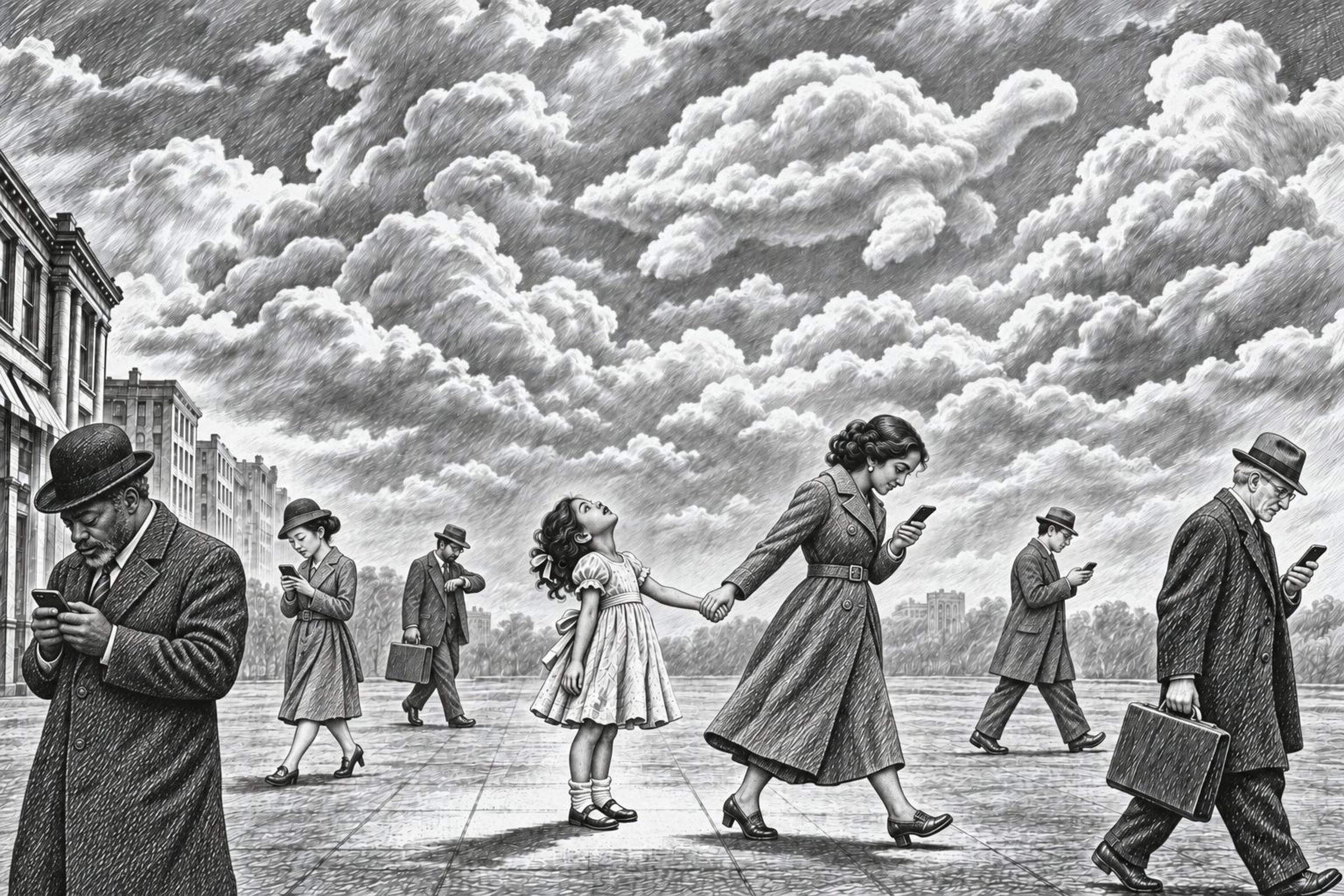
A friend of mine, Meena Das, recently told me about a little girl she watched standing with her back arched and her face pointed straight up at the sky, bent so far that she looked as if she might tip over. The girl’s mother asked what she was doing, and the girl said she was looking at the clouds. Her mother, being a mother, pointed out that she was going to hurt her neck, that she had eyeballs for exactly this purpose, and that there was no need to crank her whole head back to see what was above her. The girl did not straighten up. She asked, “How can I take in all the wonder of the clouds without moving my head back?”
The mother was right. You can see a cloud perfectly well by lifting your eyes a few degrees, and a neck is a reasonable thing for a parent to protect. Most of what we call growing up is a long education in this kind of economy, in learning to get the information with the least possible movement, and I have spent a good part of my career helping organizations do the same thing with better tools. But the girl was not after information, because she already knew they were clouds. She wanted the whole sky at once, and her body had worked out the terms without anyone teaching her.
Wonder asks for a posture that efficiency would never recommend.
I have been talking about curiosity for years. It sits at the front of the four capabilities I believe matter most in the age of AI, ahead of imagination, adaptability, and capacity, and I have always treated it as the place the story begins. But a conversation in Barcelona made me think I had been starting one step too late. I was talking with someone from the John Templeton Foundation, which has funded a good deal of the modern science of awe, and he described research suggesting that awe is less a cousin of curiosity than its precursor.
Awe is what it feels like when the world turns out to be bigger than your picture of it. That is close to the definition psychologists have worked from since Dacher Keltner and Jonathan Haidt proposed it in 2003: an encounter with something vast, whether a night sky, a piece of music, or another person’s courage, that your current understanding cannot hold, so that the understanding itself has to stretch. Keltner, who later wrote a book called Awe, and his colleagues at Berkeley have spent two decades following what happens next. In one set of studies, people who were prone to awe rated themselves as more curious, and so did their friends, who had less reason to flatter them; among 447 high school students, the tendency to feel awe tracked with how they did in school, and curiosity was the path between the two. In another, the psychologist Jonathon McPhetres ran four preregistered experiments in which he set out to produce awe on demand. In three of them people watched a sweeping nature sequence from the BBC’s Planet Earth, and in the fourth they put on a virtual reality headset and stood under the northern lights in every direction, while the comparison groups watched a funny animal video. What awe reliably produced was a sharper awareness of the gaps in their own knowledge.
Awe shows you the edge of what you know, and curiosity is the urge to walk past it.
The science is young, much of it is correlational, and McPhetres himself reported that ordinary positive emotion predicted interest in science better than awe did, so nobody should mistake a sunset for a professional development plan. Still, the thread runs further than I expected. A team led by Jia Wei Zhang found that on days when people felt more awe than usual they also did more creative things, and that the curiosity they felt that day explained the connection, which gives the path from awe to curiosity to imagination at least a diary study’s worth of support.
The rest of the path is my argument rather than anyone’s finding. The word researchers use for what awe demands of us is accommodation, borrowed from Piaget, and it means rebuilding your mental model because the old one could not hold what was in front of you. I do not know a better definition of adaptability. A person who has practiced having their picture of the world outgrown, in small and pleasant doses under an open sky, has rehearsed for the unpleasant doses: the reorganization, the new system, the job that changes shape while they are still doing it. Capacity is what accumulates on the far side of that practice, the room to carry more of what matters because change has stopped costing so much.
If awe is where the path starts, then every one of us was once fluent in it. The Harvard child psychologist Paul Harris estimates that a child asks about 40,000 questions between the ages of two and five. Warren Berger, who gathered the research on this for his book A More Beautiful Question, puts the peak at age four or five, after which questioning, in his words, “drops off a cliff.” The cliff has been measured. When researchers recorded preschoolers at home, they counted an average of 26 questions an hour, about one every two minutes, and when they followed the same children to school the number fell below two. The psychologist Susan Engel, who has spent her career watching curiosity in classrooms, found that fifth graders expressed it in any form, a question, a lingering look, a hand reaching for an object, less than once every two hours. Children do not run out of curiosity at five. The drop arrives with school rather than with any change in the child, and so it looks much more like something learned than something lost.
What changes is not the child but the reply.
A four-year-old asks open questions, and a busy world answers with closed ones: because, yes, no, not now, that will not be on the test, use your eyeballs. None of this is cruelty. It comes from parents and teachers who love these children and who also have dinner to make and a room full of other students waiting. But a child who receives enough closed answers eventually concludes that the question was the problem, and the habit that erodes is not asking in general, since adults ask for directions and deadlines all day long, but asking the deep and open kind of question that does not come with a yes or a no at the end of it. We do not become less curious people so much as we are shaped, one binary reply at a time, into people who have stopped asking that way.
I was spared some of that, though it did not feel like mercy at the time. My mother met me at the door every day after school and asked, “What is something that you noticed about the world today?” I was not allowed inside without an answer, and I dreaded the walk home. Years later she admitted that she had hated her own walk home too, because my grandfather, a geologist, had asked her the same question at the same threshold. I used to describe this as the way my mother taught me curiosity. I now think she was doing something that comes earlier, which was making me look up every day for long enough that something had a chance to be larger than I expected. When I say in keynotes that our work is not to gain curiosity so much as to protect it from a world that keeps trying to tame it, she is who I have in mind.
We have now built the most capable closed-answer machine in history. Ask an AI model almost anything and a confident, complete reply arrives in seconds, before the wondering has had time to do its work. In the 2026 research Virtuous and Fundraising.AI conducted with 346 nonprofits, 92 percent told us they were using AI and only 7 percent reported that it was meaningfully advancing their mission. I have called that a culture problem and a curiosity problem, and I think the cause sits partially further upstream. Most organizations met this technology with their eyeballs only. They asked it to save steps, which it does, and for teams as stretched as ours those saved hours are real and worth having. Far fewer have tilted their heads back and asked what their mission could become with a tool like this in the hands of people who still know how to be astonished.
I say some version of the next point in nearly every keynote I give. We are moving into a world where almost anything is possible with technology that is accessible and affordable to nearly everyone, and in that world the edge will not belong to the organization that spends the most or to the person who knows the tools best, because both of those are about to be common.
The advantage will go to the people who ask “what if” more often, and better, than everyone else.
I believe those people will be the most successful, and I believe they will be happier for it. “What if” is the question a four-year-old asks without effort and the one most of us were trained out of. An AI model will answer it brilliantly once it has been asked, but someone still has to be moved to ask it, and what moves us is rarely a spreadsheet.
The same technology that closes questions so quickly is also, by the psychologists’ own definition, an occasion for awe, since it is vast and it exceeds our current understanding. Whether we meet it with dread or with wonder depends a great deal on whether we have kept in practice. This is why I ask people to spend an hour a day in two halves: thirty minutes alone without a screen, noticing things, skipping rocks, and then thirty minutes pushing an AI model as far as it will go doing something completely unrelated to your professional work. I used to explain the first half as rest, and it is closer to a prerequisite. My own version is a walk through the Tennessee woods with my Chocolate Lab Bailey as the sun comes up, and I come back from it with better questions than I left with.
The quality of what you ask a machine depends on whether anything has recently been bigger than you.
How you look at the world is still yours to decide. The girl’s mother could not talk her into straightening up, and nothing in your calendar can make you look down if you have decided otherwise.
There are 52 weeks in a year, and how you spend them matters more than you think.
Imagine giving each of those weeks one small assignment: a week to go looking for awe on purpose, a week to ask the question you have been avoiding, a week to try the thing you do not yet understand. No single week would change much. Fifty-two of them in a row would change how you see.
That is what Meena, the friend who told me about the girl and the clouds, and I have spent the past six months building. It is a playing card sized deck called 52 Moves Forward, with one small move for each week of the year across curiosity, imagination, adaptability, and capacity, and we will be sharing it in the coming weeks. Awe is the move that comes before the first card, and it costs nothing. Go outside today and tilt your head back farther than is good for your neck. Then tell someone what you saw, because wonder that is shared tends to last longer than wonder that is kept. My mother would want to know, and so do I: what is something that you noticed about the world today?
About the Author
Nathan Chappell, MBA, MNA, CFRE, AIGP is Chief AI Officer at Virtuous Software and co-author of Nonprofit AI, The Generosity Crisis and N1 Philanthropy. He writes about responsible innovation, the future of generosity, and the power of radical connection in the age of AI.
Originally published on Nathan’s Substack.