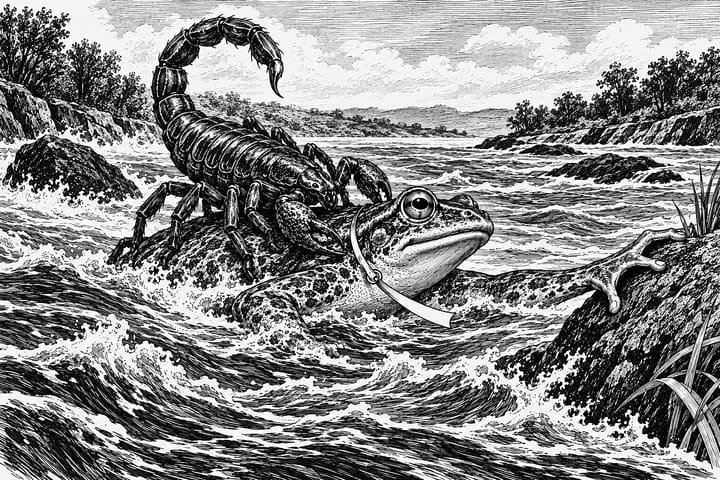
The Invisible Nonprofit
From SEO to GEO to Agentic Giving: how to be found, chosen, and remembered.

19 min read
The most important visitor to your nonprofit’s website today may not be a person, and the gift that follows may come from a donor who never sees your home page at all.
That visitor is already in the majority. In June, Cloudflare’s chief executive shared data showing that automated requests had reached about 57 percent of traffic to web pages, the first time machines have outnumbered people online. Most of those machines are not acting for donors. They are search crawlers, scrapers, and a good many bad actors, and AI crawlers and AI search bots made up roughly a quarter of the verified bot traffic Cloudflare measured in May. Agents that act on a person’s behalf are a smaller slice still, though that slice is growing rapidly and will arrive with a credit card sooner than you think.
If that still sounds like a forecast, consider what happened earlier this month. When school districts asked Google for a way to keep its AI away from students while keeping its search engine, the company’s head of education answered that Search and AI are now deeply integrated, and that a school that wants AI off would have to remove Search as well. The company that defined traditional search no longer treats it as something that can be separated from AI.
I have lived through one version of this before. In 1997 I founded the first company to sell skis on the internet, at a time when Google had not yet been founded and the search engines that decided whether a small retailer would be seen were AltaVista, Yahoo, and Lycos. The craft of getting those engines to notice you had only just been given a name, search engine optimization (SEO), and I became capable enough at it to spend part of those years consulting for other young brands that shared my problem, which was that a store nobody can find is not much of a store at all.
It was also a time when most people would not trust a web form with their credit card. We printed a catalog and ran an 800 number, because customers would peruse the catalog, browse the site to decide what they wanted, and then call to give their card number to a stranger over the phone. As we now know, the form they were afraid of was far safer than writing a paper check and handing it to someone they had never met. I think of those callers whenever I hear that giving a credit card to an AI agent is a really bad idea.
The bargain of SEO held for more than a quarter century. You made your pages visible to a machine so that a person could find them, and the machine’s work ended when it handed that person a list of links. Then, in late 2023, researchers at Princeton and several other institutions gave a name to what was replacing it: generative engine optimization, or GEO. The following year my friend Brittany Shaff and I wrote what I believe was the first article on GEO for the nonprofit sector, and our argument was that the unit of visibility had changed from the link to the answer. When someone asks ChatGPT, Claude or Perplexity which organizations are doing serious work on youth homelessness in their city, there is no second page of results to be buried on, only an answer and the handful of organizations named in it.
Andrew Dunckelman and Dale Nirvani Pfeifer, two people I respect a great deal, described that handful this fall in the Stanford Social Innovation Review, in an essay called The New Nonprofit Visibility Gap. They put it this way: “Search used to hand donors a menu. AI hands them a verdict.” The studies they cite put numbers on it. The digital agency Blue State tracked 24 nonprofit websites and found organic search traffic down 35 percent in the first ten months of 2025 compared with the same months a year earlier, and a Whole Whale study of more than 650 AI responses across twelve cause areas found the models returning in the range of a hundred unique nonprofits per cause, in a sector with more than 1.9 million registered organizations.
When I began sketching this essay, every instinct I had told me that GEO was about to give way to the agentic era, and that agentic engine optimization, or AEO, would quickly become the natural next step in a world moving this fast. Having been early to the dot-com era and then to AI, I thought the progression looked obvious. My own habits had already changed. When I wanted to understand a nonprofit I had started asking Claude before I opened a browser, knowing that it could reach Candid’s data on the organization’s 990 filings through a direct connection, and I could sense that everything about search was about to change with it. It turns out the acronym already stood for two things. The older meaning, answer engine optimization, is a close cousin of GEO. The agentic meaning is the more consequential, and it is only months old: Addy Osmani, an engineering director at Google Cloud AI, put the phrase into circulation in April of this year in a piece about making technical documentation usable by AI coding agents. That is a narrow starting point, but the idea underneath it has travelled quickly because it describes a goal different from being cited, which is being usable by software that can act on someone’s behalf.
It took roughly twenty-six years to get from SEO to GEO, and less than three to get from GEO to AEO.
If this sounds technical or far-fetched, it isn’t. Consider how you buy a car today. When it is time for me to replace mine, I might look at four or five websites, make a phone call or two, and check Consumer Reports, and then I decide, because my time runs out long before the available information does. If I hand the same question to a capable AI agent, it will read dozens of sources, compare reliability and price, and check which dealers near me have the model and the color I want, all in a few minutes. My instinct is to trust that result more than my own search, because it rests on far more research and analysis than I could have done in the time I had. I think most people will share that instinct, and I think donors will bring it to their giving.
Now apply that to a person deciding which nonprofit should receive a year-end gift. Suppose I describe to my AI assistant the causes I care about, in the kind of detail I would give a trusted advisor, and ask it to find organizations that match my values and can show they use money well. It reads their websites, checks the independent evaluators, and compares their programs. It also pulls the IRS Form 990 that most 501(c)(3) nonprofits are required by law to file and make public, and sets several years of one organization’s filings beside those of its peers, which is cumbersome enough that almost no donor does it by hand and is nearly instantaneous for an agent. Then it returns with three candidates and a suggestion for each: a recurring gift to one, a single gift to another, a volunteer shift or an advocacy campaign with the third. I approve with a click and the agent handles the rest. That is agentic giving, and this year fundraising platforms began announcing that personal agents can discover campaigns and complete authorized donations through them.
The agent will not always wait for you to be inspired. This year the major AI companies began releasing proactive agents, which you might also call anticipatory. xAI’s Grok Bot arrived in August, Anthropic opened a preview of Claude Duet in October, and OpenAI and Meta have their own, all of them built to come to you with what needs your attention instead of waiting for a prompt. Apply that to giving. An assistant whose work is deeply intertwined with yours, with access to your email, your calendar, your social activity, your past gifts, and the places where you have volunteered, does not need a question from you. In the not-too-distant future it will preemptively remind you that year-end is approaching, that it has reviewed everything you were involved with this year, and that it has already assessed a few organizations and ranked them by your values, their efficiency, and whatever else you have told it matters most. I fully expect this to be far more commonplace by the end of 2027 than most people in our sector anticipate.
There is early evidence that donors already behave this way. Dunckelman and Pfeifer report that when Giving Compass, which Pfeifer leads, ran an AI search tool inside Charity Navigator’s website for three months, donors who used it completed a gift at twice the rate of those who did not, and about 80 percent of the searches named a cause without naming an organization, which leaves the choice of organization to the machine.
Much of the fully agentic version is still early, and the announcements are running ahead of the evidence. I have not yet seen reliable data on how many gifts are completed by an agent from start to finish, and I suspect the number is small today, though it will not stay that way for long. Reading more is also not the same as judging better, as the Whole Whale finding suggests, since models with the whole web to draw on still hand back the same short list. I expect donors to trust their agents anyway, because the alternative is doing the research ourselves, and most of us never did much of it, largely because time is our scarcest resource. That trust will rest on whatever the agent finds easiest to read. Told to find efficient charities, it will reach for the overhead ratio, the measure our sector has spent more than a decade explaining is a poor stand-in for impact, and an organization judged on that measure alone is exposed to real risk. If we do not publish better evidence of what our work accomplishes, in places and formats a machine can read, analyze, and evaluate, we will have automated the overhead myth.
The practical work is therefore worth doing now, while the stakes are low, and most of it is unglamorous. Dunckelman and Pfeifer offer five steps that any nonprofit can take without a large budget, most of them about keeping the facts of your organization accurate and consistent wherever a machine might look, and I would rather send you to their list than repeat it. What follows is what I would add from my own work.
First, begin by hearing how a machine describes you. One of the first things I do when I train a nonprofit team is ask them to paste their website’s address into the free version of NotebookLM and have it play the organization back to them as a podcast or a video, and I can tell you that eyes go wide when it starts to play. For most people in the room it is their first glimpse of their agentic presence, the version of the organization that machines encounter on the outside world’s behalf, and I remind them that it is a very small sample of how these systems decide what matters about an organization. Listen for what it emphasizes, what it leaves out, and what it gets wrong. For a few people in every room the eyes go wide for a different reason, which is that nothing plays at all, because it turns out their website administrator has blocked the site from being read.
Second, find out whether the machines are even allowed in the door. Every website carries a small file called robots.txt that tells automated crawlers what they may read, or whether they may read the site at all. An analysis of about 15 million websites this September found that roughly one in ten block at least one AI crawler, and a recent conversation reminded me how many nonprofits are among them without anyone on staff having decided that they should be. Sometimes a developer added the rule years ago, and sometimes a security or hosting service applies it by default. Either way, the result is that the organization is invisible to large language models, however good its work, and as Google’s answer to the schools made plain, there is very little search left that does not run through one. There are two broad kinds of AI crawler, those that collect pages to train models and those that fetch a page in the moment to answer a question or carry out a task, and it is reasonable to treat them differently. An organization that publishes stories about children or patients may have principled reasons to keep its pages out of training data. That is a decision for leadership to make deliberately, as a matter of governance, and too often it has been made by a default setting. You do not need to be technical to check. Type your web address into a browser, add “/robots.txt” to the end, and look for names such as GPTBot, ClaudeBot, PerplexityBot, or Google-Extended followed by the line “Disallow: /” (where the slash means the entire site). If what comes back feels too technical, copy the whole page, paste it into your favorite large language model, and ask it to interpret the file and recommend changes based on what you are seeking to do. Then ask whoever manages your website one specific question this week: does our robots.txt file, or our hosting or security service, block AI crawlers, which ones, and did someone here decide that on purpose?
Third, stop assuming that one format, or one address, will carry you. These systems learn about you from text, audio, and video, and they learn unevenly, so an organization whose only account of its impact is a PDF annual report or an untranscribed gala video has left most of its story where software cannot use it. Just as important, anything you publish in a single place is a thousandth of a drop in the world’s ocean of data. Put the report on a web page, publish the transcript beside the video, and write the plain-language version of what you do. Where you publish matters as much as what you publish. I mostly write long essays, and not because anyone has told me they want to read them. I write them because it is how I work out what I think and how I learn, and I assume that anyone who does not want a long essay has already asked their language model for the summary or turned it into a short podcast. What I have learned is that the same essay leads a different life depending on where I post it. LinkedIn turns away most AI crawlers, so an essay posted only there reaches the people in my feed and has little impact outside the platform. Medium, on the other hand, blocks the crawlers that gather training data for the largest model companies while leaving its pages open to the indexes behind AI search. Substack leaves the door open unless the individual writer closes it. Each crawler also keeps its own schedule, so a piece can surface in one system almost instantly and in another only after days or months. That is why this essay appears on Substack, Medium, LinkedIn, and my own website, why I am always scouting for other places where my work can be replicated, and why a nonprofit whose best stories live only on its own website or a single social platform should assume some of the machines will never read them.
Finally, make the next step easy to take. The consistency that Dunckelman and Pfeifer ask for matters even more once agents are involved, because software that is about to move someone’s money has little tolerance for a mission statement that reads three different ways in three places, and the easy way for it to resolve the doubt is to recommend someone else. Beyond that, look at the actions themselves, the donation form, the volunteer sign-up, the advocacy pledge, and ask your giving platform what its plan is for gifts initiated by an agent, because an agent that cannot finish the task on your site will finish it on someone else’s, and you will have lost a donor before you ever knew you had one.
None of this guarantees a place on the list. A small organization can do all of it and still be left out, because the models lean on third-party ratings and press coverage that it may not have. Dunckelman and Pfeifer argue that nonprofits cannot close this gap alone and that AI labs, funders, and the sector’s data intermediaries each have work to do, and I agree. Agents raise the cost of leaving that work undone, because an answer engine that overlooks you costs you a mention, and an agent that overlooks you costs you a new relationship.
The gift is only the first thing the agent will do. What follows is my own forecast, and no doubt some of it will be wrong. I expect donors to move from one-off requests to standing instructions: a share of income, a set of causes, a few conditions, and permission to adjust. Giving begins to look like a portfolio that software reviews on a schedule, and that changes what retention means. Fundraisers have long counted on the inertia of the monthly gift, and an agent has no loyalty to your cause.
A recurring gift that an agent set up is a gift it can also reconsider.
Many recurring gifts continue today for reasons that have little to do with conviction. The donor does not have time to make a change, or cannot easily find out whom to contact, or has lost a cumbersome password, or feels a little guilty about stopping. An agent removes every one of those obstacles, so that a recurring gift can end without the donor lifting a finger or losing an ounce of sleep over it.
People already use AI this way with the rest of their spending, asking it to find the streaming services and other recurring charges that have become redundant and to save them the money, and I see no reason that review will stop at the edge of their charitable giving. At each review the agent will weigh whatever evidence it can find, and it will increasingly ask for that evidence directly. Developers are already circulating proposals for how an agent should authorize a gift, collect the receipt, and request proof of what the gift accomplished. Gabe Cooper and I call the ability to answer that request machine-verifiable trust, and we spend a good deal of our new book, N1 Philanthropy: Precision, Connection, and the Future of Generosity, on why agentic trust mechanisms are essential to build in the age of precision philanthropy. I expect nonprofits to answer those requests with agents of their own, connected to their program data, so that a question about last year’s outcomes gets a current and specific answer at any hour, and I expect the organizations that can do this to be chosen over those that cannot. The charitable version of this does not exist at scale today.
There is one instruction that overrides all of it, which is the donor telling the agent that a particular organization stays no matter what the review says. No amount of machine-readable evidence earns that instruction. In my first book The Generosity Crisis, my co-authors and I drew a line between transactional giving and what we called Radical Connection, and we argued that too many organizations had traded the second for the first. Agentic giving is the transaction perfected. The gift arrives without a visit, without a story read to the end, without the moment of being moved that has usually come before generosity.
The nonprofit receives the money and has not yet met the donor.
What happens after the gift is therefore where the relationship either begins or fails to: the thank-you that sounds as though a person wrote it, the account of what the gift did, the invitation to come and see the work.
As friction falls, experience becomes the premium. In The Generosity Crisis we argued that technology does not have to stand between an organization and the people who support it, and can be used to bring them closer. Some of the experiences that matter most are as old as fundraising. In the first machine learning work I did around 2018, we found that a person attending an organization’s event was the strongest predictor we found of a conversion to a major gift, and the signal was clearest in people who had attended three times. An experience shared with an organization settles in a person’s memory in a way that no appeal can.
The room does not have to be a ballroom, though. At a recent meeting of the Virtuous AI advisory council, which I lead with my colleague Mallory Greer, one of our members, Dan Kershaw, CEO of Furniture Bank, shared a preview link to a virtual walkthrough of his organization’s facility that his team had vibe coded themselves. You can move through it as a volunteer, as a worker, or as a constituent, and each path teaches you something different about what the organization does. They did not have to spend a considerable amount of money to build it, and it draws people in. It took curiosity and imagination far more than it took budget, and whatever the medium, I expect experience to matter more than anything else an organization offers as the friction between donor and nonprofit falls away.
It would be a mistake to read any of this as a description of the future. The future started four years ago when ChatGPT was released on November 30, 2022. Search and AI have already merged, proactive agents are already shipping, and donors are already asking machines which organizations deserve their gifts. I was early to selling on the internet and early to AI in fundraising, and my conviction about how this plays out is as strong as any I have held, which is why I think nonprofits should be aggressive and proactive right now. Put it on the agenda of your next leadership meeting. Ask the robots.txt question this week, play your website back to yourself, decide where else your story needs to live, and ask your giving platform what happens when an agent arrives. Then invest in the experiences that no agent can have on a donor’s behalf.
In 1997 I optimized my pages for a machine so that a person could find a pair of skis, and people who would not trust a web form with a card number went on to shop that way without a second thought. The machine has changed twice since then, and it can now carry a person’s intentions and their payment details all the way to your door. An organization that blocks the machine is invisible in the obvious way, and that can be fixed in an afternoon. The other kind of invisibility is harder to notice, because the gifts keep arriving: a nonprofit that an agent chose and a donor never came to know can be invisible in the heart of that donor even while the gift exists. The person is still on the other side of the machine, and sooner or later they will want to know who they have been giving to, and that introduction is still ours to make.
About the Author
Nathan Chappell, MBA, MNA, CFRE, AIGP is Chief AI Officer at Virtuous Software and co-author of Nonprofit AI, The Generosity Crisis and the new book, N1 Philanthropy. He writes about responsible innovation, the future of generosity, and the power of radical connection in the age of AI.
Originally published on Nathan’s Substack.