Faster Isn't Forward
On curiosity, overwhelm, and the discipline of knowing when to stop.

March 21, 202612 min read
By Nathan Chappell
I spent a few days in Cabo San Lucas this week, surrounded by some of the sharpest minds in our industry. Not for panels or keynotes in the traditional sense, but for the kind of open, unhurried conversation about charitable giving that rarely happens at conferences: the kind where people say what they’re actually thinking rather than what sounds polished.
I’d been asked to lead a short session called “The Curiosity Advantage: Leading Through Exponential Change Without Losing Your Mind.” Ten minutes of a thought-starter, followed by facilitated discussion. But what unfolded over the course of our time together went far beyond my ten minutes and into conversations around the pool, the bar, and throughout our meals together. It became something more honest. More searching. And, ultimately, more hopeful than I expected.
Because here’s what I noticed: the people in that room weren’t paralyzed by the pace of change. They weren’t in denial about it, either. They were sitting in the tension. Holding two things at once. The genuine excitement of what AI makes possible for mission-driven organizations, and the equally genuine exhaustion of trying to absorb it all without dropping something important.
That tension, I’ve come to believe, is not a problem to be solved. It’s the condition of leadership in 2026. And learning to hold it well might be the most important skill any of us can develop.
Let me start with what’s true.
The pace of AI innovation is not slowing down. It is accelerating in ways that make last quarter’s breakthroughs feel like ancient history. If ChatGPT turned the dial from 5 to 25, agentic AI tools like Claude Cowork just turned it to 125. And AI leaders I deeply respect, from Demis Hassabis to Dario Amodei to Geoffrey Hinton to Fei-Fei Li, are converging on a timeline that suggests something resembling artificial general intelligence could arrive in the next 900 days. Not as a philosophical thought experiment. As an operational reality.
During our time together, we sat and talked about a future for our organizations made possible by tools that didn’t exist six months ago. Not theoretically. Practically. The possibilities were staggering. A development team that once spent hours drafting donor communications can now produce deeply personalized outreach at a scale that was unimaginable two years ago. A program director can analyze outcomes data in minutes that would have taken weeks. A small nonprofit with a staff of five can operate with the strategic sophistication of an organization ten times its size. This is not hype. This is what I’m seeing in real organizations, right now, across the Fundraising.AI community and among Virtuous customers who are leaning into these tools with intention and courage.
The feeling in that room was less “How do we survive this?” and more “How do we make sure we don’t miss this?”
That’s the shift I want to name. Because too often, the conversation about AI in the nonprofit sector has been framed around risk mitigation and defensive posture. And those things matter. I’ve built much of my career around responsible and beneficial AI. But responsibility and curiosity were never meant to be mutually exclusive. For some, the belief that they are has quietly crowded out the wonder. And wonder, I think, is where the real opportunity lives.
And yet. Even in rooms full of wonder, something else is present.
There’s a word that keeps surfacing in nearly every conversation I have lately, whether it’s with tech executives, nonprofit CEOs, frontline fundraisers, or program directors. It isn’t “efficiency” or even “innovation.” It’s relevancy.
How often do you think about your own relevance? Not in the abstract, philosophical sense. In the practical, honest sense. The kind of question that makes you wonder whether the skills you spent fifteen years developing will still matter in three.
Whether your organization’s model, which served communities beautifully for a decade, will still be the right model in a world where AI is reshaping expectations for speed, personalization, and impact measurement.
I asked a version of this question during our session, and the room got quiet. Not because people didn’t have answers, but because the question itself carried weight that most of us had been carrying privately.
Here’s what I think is happening beneath the surface.
The relevancy anxiety is real. And for mission-driven people who are deeply invested in their work, that anxiety doesn’t produce paralysis. It produces acceleration. When you’re not sure whether your expertise will hold, you compensate by doing more. When you’re not sure whether your organization is keeping pace, you work faster.
When you see a tool that could help you stay afloat, you grab it. And you don’t let go. Not at lunch. Not in the evening. Not on the weekend.
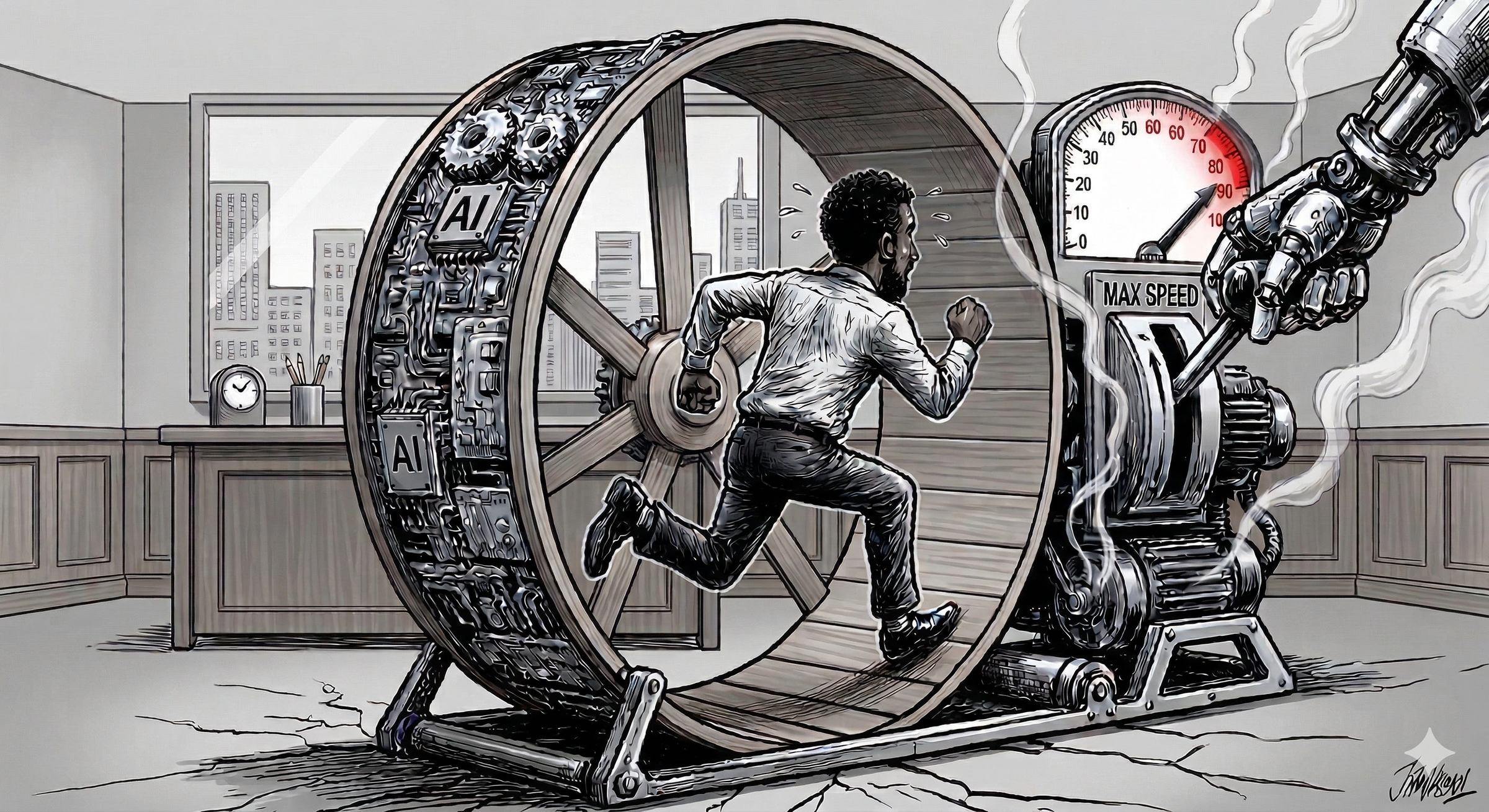
A few days before the trip, I read a piece in Harvard Business Review by researchers Aruna Ranganathan and Maggie Ye that gave language to exactly this pattern. They had spent eight months studying how generative AI changed work habits at a mid-size technology company, and their central finding confirmed what I’d been sensing: AI tools didn’t reduce work. They intensified it.
Not because anyone mandated longer hours. The intensification was voluntary. Workers started taking on broader responsibilities because AI made new tasks feel suddenly accessible. Work became ambient, with people slipping prompts into moments that used to be pauses, during lunch, between meetings, right before leaving the desk, none of it feeling like overwork until the natural rhythms of rest and recovery had quietly disappeared. And the multitasking multiplied, with people managing several AI-assisted threads at once in a state that felt like momentum but was actually cognitive fragmentation.
The finding that stayed with me was this: many workers reported feeling more productive. Almost none reported feeling less busy. The time savings that AI created didn’t produce breathing room. They produced capacity for more. And human nature filled the vacuum.
For the nonprofit sector, where burnout is already endemic, where 95 percent of leaders express concern about it, and where mission-driven people are already inclined to give more of themselves than any reasonable person should, this pattern isn’t theoretical. It’s an accelerant poured on an existing fire.
But here’s the part I don’t want you to miss, because it’s the reason I’m writing this piece with hope rather than alarm.
The researchers didn’t argue against AI adoption. They argued for something more thoughtful: the need for what they called an “AI practice,” a set of intentional norms that structure how AI is used, when it’s appropriate to stop, and how work should and should not expand in response to newfound capability.
And this is where I think the nonprofit sector has a remarkable, perhaps even historic, advantage.
We are already a sector built on mission alignment. We already ask questions about purpose, about who we serve, about whether our actions reflect our values. The tools for discernment exist in our DNA. What we haven’t done yet is apply that discernment to how we adopt AI itself.
Think about it. Nonprofits are uniquely positioned to be the most thoughtful AI adopters on the planet. We operate in a currency of trust. We are accountable to communities, to donors, to the public good. We don’t have shareholders demanding quarterly acceleration.
We have missions demanding long-term fidelity. That’s not a limitation. That’s a superpower. If we choose to see it that way.
The sector’s historically cautious approach to technology adoption, which has sometimes been characterized as a weakness, can be reframed as strategic wisdom. Not slowness for the sake of slowness, but the kind of deliberate pace that allows organizations to adopt with eyes open, to integrate AI in ways that amplify what matters rather than simply accelerating what’s already moving too fast.
And the key to unlocking that advantage, I believe, is the very thing I noticed in the people who leaned forward during the hardest questions that week: curiosity.
After the morning sessions had wrapped, I found myself chest deep in the pool with Brian Forde, CEO and Co-Founder of Numero, in one of those conversations that starts casually and turns into something deeper. We were talking about what actually makes someone valuable in an era where AI can do so much of the analytical heavy lifting.
For most of the last century, we prized professional value by IQ, the ability to know, analyze, and solve. More recently, we’ve learned to prize EQ, the ability to connect, empathize, and lead with emotional intelligence. Both still matter.
But Brian and fixated on a third quotient, one we don’t talk about nearly enough: CQ. Your Curiosity Quotient. And unlike IQ, it isn’t fixed.
Curiosity, which I speak about often, is the real competitive advantage of this era. Not technical sophistication. Not early adoption. Not even strategy, at least not in the traditional sense. Curiosity.
I’ve written many articles about this, about curiosity as a human superpower in the age of AI. But what this week clarified for me is that curiosity operates on two levels simultaneously, and the tension between those levels is precisely where leadership happens.
On the first level, curiosity is the force that keeps you from freezing when the ground shifts. It’s what makes you ask “What if?” instead of “What now?” It’s the difference between paralysis and momentum, and it almost always comes down to choosing better questions over faster answers.
The people in that room who felt energized by the relevancy question rather than threatened by it? They were the curious ones. Not in the soft, passive sense. Curious in the way that treats uncertainty as an invitation rather than a verdict.
On the second level, curiosity is also the thing that whispers “just one more.” One more experiment. One more prompt. One more tool to explore. For every entrepreneurially minded person, curiosity isn’t just a compass. It’s also an accelerant. And unchecked, it feeds the very intensification that the Harvard researchers documented.
This is the balance that I think matters more than any technology decision a nonprofit leader will make this year. How do you stay curious enough to seize the extraordinary opportunity that AI represents, while building the discipline to protect yourself and your team from the ambient creep of work that never stops?
The answer, I think, is not personal willpower. It’s structure.
My good friend Cherian Koshy posed a question to me recently that I haven’t been able to shake: What would it actually mean for your organization if adaptation became a core strategy, not just a reaction to disruption?
Most organizations treat adaptation as the thing you do when something breaks. When a technology shifts. When funding changes. When the world throws a curveball. Adaptation is the response. It’s reactive by nature.
But what if adaptation were the starting point? What if curiosity weren’t just something you encouraged in a team meeting but something you built into the operating model? What if the question “What are we learning?” carried as much weight in a board meeting as “What did we accomplish?”
This is where the Harvard research becomes genuinely useful, not as a cautionary tale, but as a design brief. The researchers proposed specific structural norms that I believe are especially important for mission-driven organizations.
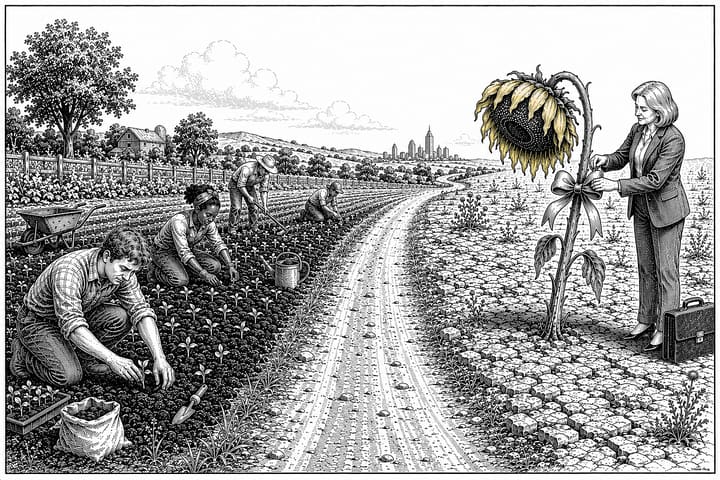
The first is intentional pauses. Not more meetings. Not strategic retreats. Brief, structured moments built into the rhythm of work that create space for someone to ask: Am I still aligned with what matters? Has the scope of what I’m doing expanded without anyone deciding it should? Is this pace sustainable, or am I running on fumes dressed up as momentum?
One version of this I’ve been recommending is what is called a “decision pause.” Before any significant decision is finalized, someone on the team is responsible for offering one counterargument and one explicit connection to organizational mission.
It introduces a moment of deliberate friction into a system that AI has made dangerously frictionless. And friction, when placed with intention, isn’t the enemy of progress. It’s the guardian of discernment.
The second is human grounding. As AI enables more solo, self-contained work, the quiet risk is isolation. A development officer who used to brainstorm a case statement with a colleague now drafts it with an LLM. A program director who used to ideate with peers now generates options in parallel with an AI assistant. The work gets done. Maybe faster. But something is lost in the process, and what’s lost is exactly what nonprofits cannot afford to surrender: the creative friction and relational depth of human connection.
Human grounding means protecting time and space for listening. For structured dialogue. For the kind of conversation that doesn’t have a prompt and doesn’t produce an output, but that restores perspective, generates surprise, and re-anchors the work in the social context that gives it meaning.
This is one of the reasons I host a monthly gathering I call the Dinner of Extraordinary Humans. Phones off. No agenda beyond deep conversation about what matters. It has nothing to do with productivity and everything to do with the kind of connection that keeps people whole in a world that is accelerating beyond anyone’s ability to fully comprehend alone.
AI provides a single, synthesized viewpoint. Human conversation provides surprise, disagreement, empathy, and the spark of an idea that nobody in the room expected. Organizations that protect space for that kind of exchange will not only avoid burnout. They will out-innovate organizations that don’t. Because real creativity doesn’t emerge from speed. It emerges from the collision of perspectives that only humans, in relationship with each other, can produce.
AI is as much a cultural shift as it is a technological one. The tools are extraordinary. The opportunity for nonprofits to amplify their missions, deepen their impact, and serve their communities with unprecedented sophistication is real and growing. I see it every day in my work at Virtuous, across the global Fundraising.AI community, and in the organizations that are choosing to explore with intention rather than adopt with anxiety.
But the cultural shift is the harder part. Because culture can’t be upgraded overnight. It has to be practiced. Intentionally. Repeatedly. With the kind of discipline that looks, from the outside, like slowness, but that is actually the deepest form of strategic intelligence I know.
Stay curious. Build the pause. Protect the connection. And remember that the goal was never to do more. The goal was always to do what matters, and to do it in a way that sustains the people who carry the mission forward.
The pace of change will continue to accelerate. That is beyond any of our control. But how we respond to it, the posture we bring, the culture we build, the questions we ask, that is entirely ours.
And if there’s one thing I took away from my days in Cabo, it’s this: the organizations best positioned for what’s coming aren’t the ones with the best technology strategy. They’re the ones building cultures of curiosity that can absorb exponential change without breaking. Cultures that treat wonder as a discipline, not a luxury. Cultures that know how to move fast and also know how to stop.
That’s the curiosity advantage. And it belongs to anyone willing to claim it.
Nathan Chappell, MBA, MNA, CFRE, AIGP is Chief AI Officer at Virtuous, co-author of Nonprofit AI and The Generosity Crisis. He writes about responsible innovation, the future of generosity, and the power of radical connection in the age of AI.
Originally published on Nathan’s Substack.