AI Fatigue Is Real. But Avoidance Won't Stop What's Coming
Leadership, humility, and the cost of looking away.

February 4, 20269 min read
I had a conversation recently that has stayed with me.
A thoughtful conference organizer reached out to invite me to speak later this year. The invitation was generous, the intent sincere, and the mission deeply aligned with my own. As we talked through the session, though, there was a gentle hesitation. Then it came plainly, without drama or defensiveness.
“We’ve gotten feedback that people are really fatigued by AI. Would you be open to not using the word at all?”
I understood immediately. I didn’t feel dismissed or constrained. I felt empathy. Anyone who has spent time in nonprofit leadership over the last few years knows this feeling well. The sector has been absorbing wave after wave of disruption while carrying the emotional weight of real human need. Burnout is not hypothetical. Fatigue is not a lack of intelligence or curiosity. It is a physiological and psychological response to sustained acceleration.
And still, the question lingered long after the call ended. Not because the request was unreasonable, but because it revealed something deeper about the moment we are in.
What happens when avoiding a word becomes a strategy for coping with change?
For most of human history, language has been one of our primary tools for managing uncertainty. When something feels overwhelming, we soften the edges. We rename it. We talk around it. We postpone it. This is not denial. It is protection. In times of rapid change, people instinctively look for ways to regain a sense of control, and controlling language is one of the most accessible levers we have.
I’ve written before about this dynamic through the lens of cognitive dissonance, how our brains instinctively seek relief, not truth, when faced with sustained uncertainty. When information threatens our sense of stability, the mind looks for ways to reduce discomfort. Avoidance, minimization, and language softening are not signs of weakness. They are deeply human responses to overwhelm. But what protects us emotionally in the short term can quietly cost us agency over time.
That distinction matters, especially now.
AI fatigue is real. I hear it everywhere, and I recognize it in myself. I’ve been working with AI since 2017, back when it was obscure, inaccessible, and unaffordable for most nonprofits. In those early days, if someone mentioned “artificial intelligence” across a loud airport, my attention would snap to it instantly. I was intensely curious about what the one percent was experimenting with and what might eventually become possible for the rest of us.
Today, the dynamic has flipped. AI is seemingly everywhere. In every conversation. Every headline. Every product pitch. It has reached a level of saturation that can feel exhausting, even numbing. If there is one topic I am no longer allowed to bring up at the dinner table, it is AI.
People are tired of breathless headlines. Tired of tools they did not ask for. Tired of being told they are either falling behind or racing ahead when most days they are simply trying to serve their communities well.
I have deep compassion for that exhaustion because I have lived both sides of it.
But compassion does not require avoidance. And avoidance has never slowed reality.
There is a subtle danger in confusing silence with safety. Not talking about something does not reduce its influence. It simply changes who shapes it. History is full of moments where major shifts continued unfolding whether or not institutions were ready to name them. The choice was never between engagement and stability. It was always between engagement and diminished agency.
What makes this moment feel different is not just the technology itself, but the scale and pace of what it represents.
We often compare AI to transformative technologies of the past: the printing press, radio, television, the internet. Each reshaped society in profound ways. But AI is not simply another chapter in that sequence. It is an accelerant to all of them at once. It compresses time, collapses distance between intention and execution, and fundamentally alters how value is created.
I often say this plainly because it helps reset the frame:
AI dwarfs all other technologies combined.
Not because it replaces them, but because it amplifies them. It changes how work is done, how success is measured, how possibility is assessed, and how expectations are formed. When you view AI through that lens, fatigue is not surprising. It is rational.
We are not just seeing new tools emerge. We are watching the structure of work change in real time. Response times, personalization, analysis, creativity, decision-making. What once felt exceptional now quietly becomes baseline. These expectations are not being set by the nonprofit sector, but they are being imported into it through every donor interaction, every digital experience, and every comparison to the rest of the world.
This is not a story about nonprofits being behind. That framing misses the point entirely. The sector is not lagging. It is overextended.
Nonprofit professionals are navigating donor databases, CRMs, automation platforms, compliance requirements, privacy concerns, and ethical tradeoffs every single day with limited staff and finite resources. They are not reckless. They are resourceful. Fatigue emerges not from incompetence, but from care.
I come to this conversation with that reality deeply ingrained in me, because my identity in this space did not begin as a commentator or consultant. I identify as a fundraiser. I spent two decades in nonprofit leadership, carrying responsibility for teams, revenue, and mission outcomes that had real human consequences. My early work with machine learning did not begin as a trend. It began as an attempt to solve constraints I was living inside of.
Even now, working in the private sector, that identity has not shifted. I still experience this work through the lens of a fundraiser, shaped by years of shared constraints and accountability. Staying close to nonprofit practitioners matters to me, not as a credential, but as a compass. It keeps me attentive to how ideas land, not just how they sound.
That posture matters here.
Fear-mongering almost always comes from distance. It speaks about people rather than with them. It questions intelligence instead of interrogating systems. It uses urgency as leverage rather than treating it as a responsibility. What I am trying to do is not amplify fear, but reduce confusion. And confusion thrives when we avoid naming what is quietly reshaping the work around us.
Much of what people describe as AI fatigue is not actually about artificial intelligence at all. It is tool fatigue. Endless demos. Endless platforms. Endless promises of efficiency layered onto already full plates. When change shows up as a parade of products, exhaustion is a rational response.
I have argued elsewhere that this is where we often get the framing wrong. When AI is introduced as a growing stack of tools to adopt, it feels additive and burdensome. Another thing to learn. Another system to manage. Another demand on already scarce time and attention. But that framing misses what is actually unfolding. This moment is less about adoption and more about evolution, a shift in how work itself is conceived, structured, and carried out.
When we mistake a foundational change for a shopping list of tools, fatigue is inevitable.
(For a deeper exploration of this, see my Substack article “From Adoption to Evolution.”)
The deeper shift underway is not arriving as a toolset. It is arriving as a redefinition of work itself. What requires human judgment? Where does trust live in a process? What should remain deeply relational, and what can be responsibly augmented? These are not technical questions. They are leadership questions.
Change and fatigue have always gone hand in hand. Whenever the world shifts faster than our ability to integrate it, exhaustion is a natural byproduct. Fatigue is often the signal that the underlying change is not incremental, but structural.
Across history and organizations, people tend to fall into a few broad camps. Some are energized by change. They lean in early, experiment, and adapt quickly. Others prefer to watch from the sidelines, waiting for clarity, best practices, or proof that the risk is worth taking. And then there are those who resist change, not out of stubbornness, but out of a desire to preserve what once worked, what felt stable, and what made sense in a different context.
In slower eras, all three postures could coexist without severe consequence. Fatigue could subside because the environment eventually stabilized. “Later” was a legitimate strategy because the pace of change remained within human limits.
This moment is different.
The pace of change has crossed a threshold where avoidance is no longer neutral.
For those in the middle and latter categories, this will be the ultimate test, not of intelligence or intent, but of adaptability. The systems shaping our work are evolving whether or not we feel ready.
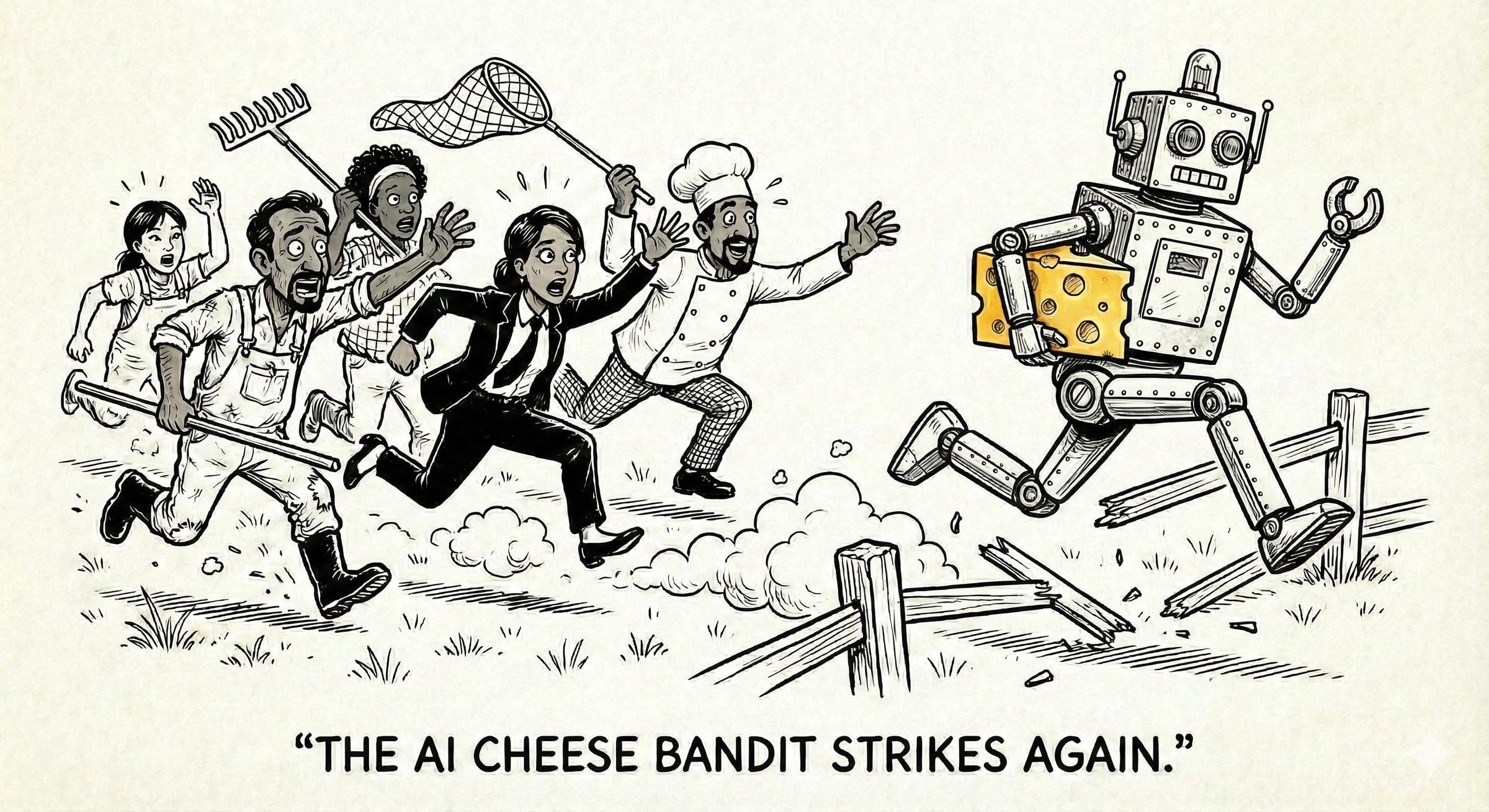
In the language of an famous parable, AI moved your cheese, and it’s not coming back. Not metaphorically. Structurally. The work has shifted. Expectations have shifted. The environment has shifted.
The real opportunity in this moment is not for those who enjoy change for its own sake. It is for those willing to develop the capacity to adapt faster than the environment changes. That capacity is no longer a personality trait. It is a professional requirement.
One of the most helpful frames I’ve encountered comes from my friend Cherian Koshy:
“The work is no longer about managing change. It is about learning faster than change.”
Managing implies control. Learning implies humility, curiosity, and adaptability. In an environment where expectations shift quickly, the organizations that remain resilient are not those that avoid the conversation, but those that create space for shared learning without panic.
This does not mean every keynote, training or internal meeting needs to center AI explicitly. Language matters, and so does pacing. We can reduce the volume without reducing the truth. But avoiding the conversation entirely does not serve the people we are trying to protect.
Naming what is happening is not an act of fear. It is an act of care.
The nonprofit sector does not need more alarmism. It also does not need denial. What it needs is honest, grounded leadership that respects the intelligence, wisdom and discernment of practitioners while acknowledging the new math of success this moment brings.
You do not have to lead with the word “AI.”
But you also can’t avoid it’s impact. do have to lead with honesty.
The future does not require our permission to arrive. But it will be shaped by those willing to confront our shared reality with honesty and care.
About the Author
Nathan Chappell, MBA, MNA, CFRE, AIGP is Chief AI Officer at Virtuous Software and co-author of Nonprofit AI and The Generosity Crisis. He writes about responsible innovation, the future of generosity, and the power of radical connection in the age of AI.
Originally published on Nathan’s Substack.